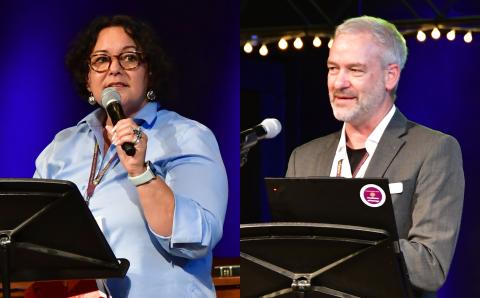
The Christian Reformed Church in North America longs to be faithful. To be renewed. To be united. At Synod 2026, meeting June 12-18 in Grand Rapids, Mich., members who served as delegates did their best to move the car a little further down the road, but there were bumps and swerves.
Mark Verbruggen, Classis Hamilton, observed, “Right now I feel like the doctrinalists are in the driver’s seat, the pietists are riding shotgun, and the transformationists like myself have been relegated to the back seat, and that’s OK. … We’re all in the same car, and we’re all going in the same direction.”
Direction—toward a 10-year plan for planting churches together—was set early on, with what seemed like enthusiastic buy-in as multiple delegates voiced “I’m in” or “I’m all in,” and all of synod stood in applause for the blessing of a unified plan.
But the body began feeling less together as more of its advisory committees reported and floor discussion followed the familiar “for” and “against” pattern.
President Chad Steenwyk gently discouraged requesting vote counts, but the few that were given showed fairly even splits, for example 93 to 84, with one abstention, in favor of commissioning a study on Christian nationalism.
Votes sometimes swayed one way and then the other, such as over the recommendation to remain in cooperation with the Dutch denomination Nederlandse Gereformeerde Kerken. Amidst arguments against the move, synod chose to extend the in cooperation ecumenical status, but it also adopted instructions to narrowly guard the relationship, reiterating to the NGK the CRC’s position on human sexuality and affirming the CRC’s willingness to “guide, mentor, and disciple the NGK on the issue of human sexuality.”
In a few instances synod did not take the recommendation of its standing committee or interim committee and forged its own recommendations—dismissing a team formed in 2022 to promote the dignity of all members in situations of hurt in the church and exiting a communion of churches over moral and social justice stances that the majority of the body could not abide.
That decision, objected to with nine negative votes and one formal protest, which the officers of synod said they had no category for, went against the recommendation of the Ecumenical and Interfaith Relations Committee, which had reviewed the concerns and benefits of continued CRC involvement. The committee noted, “According to their ecumenical charter, decisions by the World Communion of Reformed Churches are not binding on members. The communion does not have authority over their members,” and, “Through the WCRC, the CRCNA can contribute meaningfully to global Christianity, particularly in contexts where theological resources and institutional support are limited.”
Synod said “no” to a study committee on ecclesiology, with some delegates saying such a report is too late in the game and that the doctrine on what the church is to be, is already clear; but synod said “yes” to redefining the CRC’s mission and vision statements. It wants to keep meeting annually despite the cost and, although it rejected a request to allocate 50% of received ministry shares to the denomination’s mission agencies, synod did ask for more financial transparency and recommended churches contribute 6-12% of their annual operating budget toward shared expenses, while hearing that some congregations can and do give more than that already.
Rules of the Road
Synod 2026 passed several changes to the CRC’s ecclesiastical rule book, Church Order—deleting out-of-date guidelines for Classis Red Mesa; updating the article for commissioned pastors; adding a supplement to describe how multisite congregations can function; adding specifics to the article about consistories regulating worship services; including “prayer” in the description of a minister’s call; adding provisions to Article 83 to allow discipline, in exceptional circumstances, by a broader assembly; and adding a couple of words to the Article 5 gravamen process that has tripped up some congregations since Synod 2024 removed any ambiguity about the potential for long-term exceptions to doctrinal conscription.
Changes or additions to the Church Order Supplement can go into effect now, but changes to the articles themselves need to be proposed by one synod and ratified by a subsequent synod. The Covenant for Officebearers, which serves as the doctrinal statement that pastors, elders, and deacons in the CRC sign to indicate their agreement with the confessional standards of the church, is referenced in the Church Order. Synod decided that its proposal to remove reference to the contemporary testimony in the Covenant is significant enough that it should be ratified by a later synod.
Who Can Drive?
Synod considered changing membership requirements for Council of Delegates members, but decided not to restrict nominees to current or former officebearers.
For board members of Calvin University, Calvin Theological Seminary, and other denominationally appointed positions, Synod 2026 accepted the rubrics requested by Synod 2025, and synod made no change to the denominational employee policy of distinguishing between direct ministry staff and ministry support staff when it comes to requiring confessing membership in a Christian Reformed congregation. Synod was satisfied with Calvin’s efforts to see faculty and trustees in alignment with the church’s confessional convictions.
Having decided last year that The Banner would “speak from a distinctly Reformed perspective in line with our confessions and synodical decisions, representing the CRCNA as its official publication,” Synod 2026 appointed the publication’s new editor-in-chief under the updated mandate. The first woman to be appointed to the role, Lora Copley has been serving as interim editor since December.
Synod also interviewed and appointed a new professor of Old Testament to the seminary, Christopher Fantuzzo, Ph.D.
Synod approved and celebrated 36 new candidates for ministry in the Christian Reformed Church, almost double the number of candidates approved in 2025.
How Far Will We Go?
Online ministries, to which Synod 2025 gave the green light to experiment, can be anywhere and everywhere all at once, but they can’t take the name “church,” Synod 2026 said.
In some places we might contract. In previously established classes, such as Yellowstone and Grand Rapids East where the number of participating churches has been reduced to five or seven congregations, mergers or reconfiguring might be in the works. Synod approved creating a task force to make recommendations about consolidations and/or overall restructuring of classes to Synod 2028, noting its primary goal should be to ensure healthy classes. Synod also asked the Office of General Secretary to aid any current classes working toward mergers, without having to wait for the completion of the task force.
In other places, the CRCNA is reaching further. Synod took note of the ongoing work of the Global Vision Team, expecting a report to Synod 2027. General secretary Zach King mentioned that the team, approved by Synod 2024 to strengthen relationships with churches outside North America, became necessary because of classes naturally making international connections. Venezuelan churches that have affiliated through Classis California South had representation at Synod 2026 in California South delegate José Piñero. And Synod 2026 heard presentations from several diverse communities within the CRC, learning that 30% of the denomination is non-white.
The CRCNA longs to be faithful, renewed, and united. Are we there yet? No, but we just might be a little further down the road, in the same car, with a little bit of jostling for the wheel.
Synod president Steenwyk reminded the group that the way to keep the spark for the new vision that was ignited at Synod 2026 is to rest in God’s faithfulness to accomplish his purposes. “It is a new day in the CRC … because his mercies are new every morning. Great is his faithfulness.”
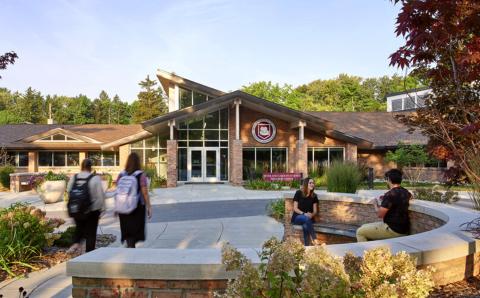
Synod 2026, the annual general assembly of the Christian Reformed Church in North America, met June 12-18 on the campus of Calvin University in Grand Rapids, Mich. Go to crcna.org/synod for plenary recordings, photos, and reports. Find daily news and our video Synod Recap at thebanner.org/synod.
About the Author
Alissa Vernon is the news editor for The Banner.