Every December, Christian Reformed churches across North America put up trees, light candles, and retell the familiar story of God becoming flesh and moving into the neighborhood. The neighborhoods themselves, however, could hardly be more different.
On the Zuni Pueblo in New Mexico, a congregation celebrates quietly in a community where the season carries a different, culturally rooted meaning. In rural Kansas, a church takes its candlelight service down the road to a retirement home so members who can no longer attend church can still share in Christmas. A congregation in Langley, B.C., uses Advent to buy livestock for families on the other side of the world, while a church in Edmonton welcomes the crowds already drawn to its neighborhood’s Christmas lights. In Waupun, Wisc., another congregation goes even further, rebuilding the streets of Bethlehem in its own backyard.
These five churches experience five very different Advents, yet a common thread runs through them all. Each congregation has taken something familiar such as a worship service, an offering, a tree, and allowed its particular community to reshape it into a tradition that could not fit anywhere else in quite the same way. In some respects, that instinct captures the heart of Advent itself: Christians wait for God to arrive not in the abstract, but in the middle of real places and particular circumstances. Every December, these congregations do something similar, receiving the same hope and allowing it to take the form their own community needs.
Giving Instead of Getting: Willoughby CRC, Langley, B.C.
At Willoughby CRC, the countdown to Christmas begins with a bare tree and a box of paper ornaments. Deacon Jackie Hofstede explained that the congregation has been decorating what it calls the Giving Tree since 2013, although no current deacon remembers exactly how the tradition began. What people do remember is the simple way it works: members choose a paper ornament printed with an item from World Renew’s gift catalogue, fill it out with a pledge, and return it to the tree. Some ornaments represent a goat, others a flock of chickens or a garden starter kit. The completed pledges go to World Renew, while the actual gifts make their way to families who need them far more than anyone gathered around the Willoughby tree.
In 2022, the congregation took the tradition a step further. Working with World Renew, the deacons set a goal of funding several of the organization’s “bestseller” bundles, each a $4,000 package that combines livestock, tools, and seeds into one gift with the potential to change a family’s circumstances for years. Hofstede said Willoughby has surpassed that goal every year since, a streak now heading into its fifth season.
Individual ornaments remain part of the tree alongside the larger campaign, and Hofstede has noticed that people are beginning to use them differently. Instead of buying another toy for a grandchild who already has plenty, some families now choose a gift that reflects the person they want to honor. They might purchase a garden bundle or a flock of chickens through World Renew, then give their loved one a card explaining that the gift was made in their name. It is a practice Hofstede has adopted with her own family as well.
“It’s something that we as a church enjoy giving to,” Hofstede said. Newer members, she added, have responded warmly to a tradition centered on helping others rather than accumulating more for themselves. She is not sure why the deacons originally chose a tree and paper ornaments as the vehicle for that generosity, but perhaps the explanation is simple: some traditions take root because they work.
A Quiet Season in a Sacred Place: Zuni CRC, Zuni, N.M.
Fifteen hundred miles to the south, in the heart of the Pueblo of Zuni, Christmas looks almost nothing like it does in Langley, B.C. Pastor James Zwier has served Zuni CRC for four years, ministering to a congregation of about 150 members on land where, as he put it, the church has been a guest for about 127 years.
Zwier explained that Christmas in Zuni arrives during one of the most sacred periods in the traditional Zuni religious calendar. The winter solstice begins a fast that typically lasts from four to 10 days and often falls immediately before Dec. 25. Fewer than 2% of the Pueblo’s residents identify as Christian, and during the fast the community observes strict traditional prohibitions, including a rule against turning on outdoor lights. As a result, there are no strings of Christmas lights, glowing Santas, or other bright displays competing for attention; the visual noise that marks the season in so many places simply is not part of December here.
“It certainly feels different than celebrating Christmas in Canada or Western Michigan or Iowa,” Zwier said, “where just about everybody’s celebrating it, maybe not so Christian-ly anymore. Here, hardly anybody's celebrating Christmas at all.”
Rather than resisting that quiet, Zuni CRC has learned to live and worship within it. Before the fasting period begins, members go caroling through the community, stopping at homes to sing and offer a blessing. Zwier said even neighbors who otherwise have little connection to the church look forward to these visits and often send the singers on their way with food or a small gift. From one year to the next, the congregation alternates between Christmas Eve and Christmas Day services, then brings the season to a close with a community potluck.
Christmas at Zuni CRC is shaped less by decoration than by prayer, offered quietly in a place where the surrounding community is deeply engaged in its own sacred observance. “Christmas is a time when believers especially feel the need to be supported in prayer,” Zwier said, “because of the traditional religion being so strong at that time of year.”
There are no pageants competing for attention on Main Street and no expectation that the wider community will notice or join in. Instead, the small group of carolers moving from house to house has become a quiet witness of its own, reminding the congregation that the church belongs to its neighbors as much as it belongs to itself.
Bringing Christmas to Those Who Can't Come to It: Luctor CRC, Prairie View, Kans.
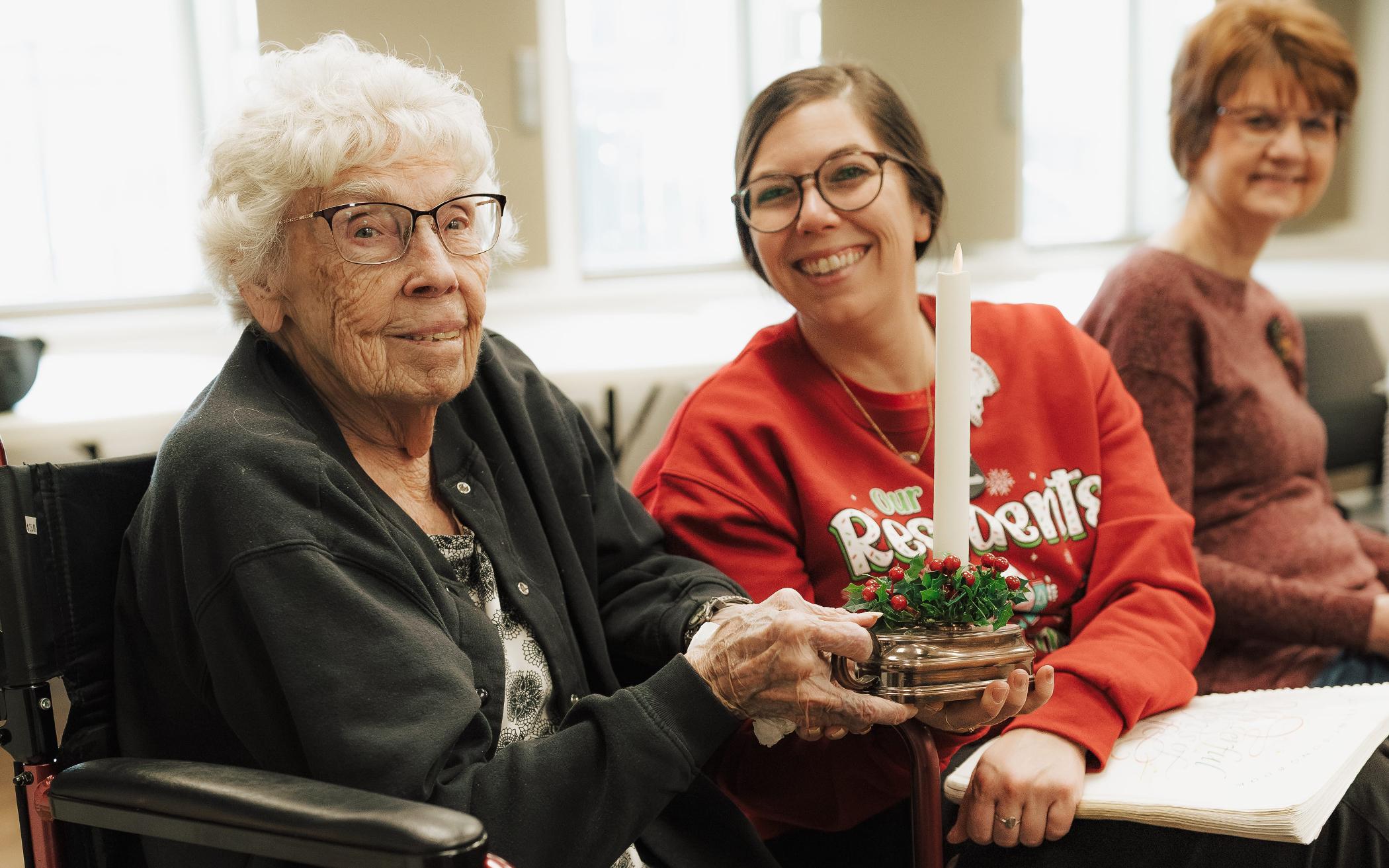
In Prairie View, Kans., Luctor CRC found its own Christmas tradition by paying attention to someone who was no longer there. Pastor Shawn Richardson recalled a longtime member who had rarely missed an evening service. When the man moved to Logan Manor, the local retirement center, and could no longer attend, the church responded by bringing the evening service to him. Over time, that simple act of care reshaped the way the congregation approached Christmas itself.
Logan Manor is now home to Luctor’s Christmas candlelight service, which took place for the second time in 2025. Inside the retirement home, the congregation works to preserve every familiar part of the tradition, from the candle lighting and decorations to the full Advent liturgy. Richardson said the invitation extends beyond church members to all Logan Manor residents and their families, including many who have no other connection to the congregation. One family told him that, amid the upheaval of moving a loved one into long-term care, the service gave them a brief and deeply welcome sense of normalcy.
Attendance doubled from the first year to the second, a change Richardson attributes to the congregation’s growing recognition of how much these older members have contributed to the life of the church. “They remember Sunday school taught by these older folks,” he said. “They remember seeing them standing up in front of everyone as elders.” The Logan Manor gathering does not replace the congregation’s traditional Christmas Eve service; it stands beside it. Two church members now also work at Logan Manor, strengthening the relationship through their roles as neighbors and caregivers. Christmas Eve has become more than simply the night before Christmas morning. It is now a night when the whole church gathers around the same light, wherever its members happen to live.
Walking Into the Story: First CRC, Waupun, Wisc.
While Luctor CRC brings Christmas to people who cannot easily come to church, First CRC in Waupun, Wisc., invites the wider community to step directly into the story. Every other December for the past six years the congregation has transformed its grounds into “A Night in Bethlehem,” an interactive walk-through recreation of the ancient town on the night of Jesus’ birth.
Elder Mike Vandenberg said the event began as a way to help people encounter the nativity story with fresh eyes, and it has become one of the congregation’s most anticipated outreach efforts. Led in small groups through a recreated marketplace, visitors meet merchants and townspeople, sample foods inspired by the biblical era, and eventually arrive at a live nativity scene. Last December, more than 200 people from Waupun and the surrounding area walked the streets that First CRC had built.
What lifts the event beyond historical reenactment, Vandenberg said, is the guide who accompanies each group and threads the larger gospel story through the journey. The walk concludes at a cross, where visitors hear a short reflection connecting Christ’s birth with his death and resurrection. “Our prayer is that every visitor leaves not only with a memorable Christmas experience,” Vandenberg said, “but also with a clearer understanding of the hope that is found in Jesus Christ.”
The event has also changed the congregation from within. In the weeks before each presentation, dozens of volunteers build sets, sew costumes, and rehearse their parts, and that shared work has drawn the church closer while deepening its sense of calling to its neighbors.
Meeting the Neighborhood on the Corner: West End CRC, Edmonton, Alta.
West End CRC in Edmonton, Alta., sits beside Candy Cane Lane, a residential street known across the city for its elaborate Christmas light displays. For years, the church watched December crowds pass by without finding a meaningful way to connect. Lisa Vander Leek, who helps lead the church’s outreach efforts, said that changed two years ago when the congregation chose to welcome the foot traffic already arriving at its doorstep rather than ignore it or try to compete with it. On average, about 300,000 people visit Edmonton’s Candy Cane Lane over its month-long opening.
The result is a season-long welcome designed around the people who come to see the lane. On selected evenings, the church closes its parking area to vehicles and opens it to pedestrians, turning what is usually a shortcut into a small community gathering place. In partnership with a nearby Tim Hortons, West End offers Timbits and hot chocolate, while an ice-sculpture nativity gives visitors a place to pause. Firepits along the route create warm gathering points for an event the outreach team calls Cocoa on the Corner.
For Vander Leek, the lights have never been the point; what matters are the conversations that unfold around them. Volunteers tend the firepits and spend time talking with neighbors, many of whom have no other connection to the church. The effort grew from a simple change in outlook. Instead of waiting for the neighborhood to come looking for them, members of West End decided to become more present on their own street and meet people where they already were.
One Story, Many Streets
Together, these five congregations show how differently the same story can be told when it is shaped by the people and places telling it. At Willoughby CRC, an offering has become an act of imagination, inviting members to picture a particular family receiving a garden bundle or a flock of chickens. Zuni CRC has learned to practise its faith quietly and faithfully during a season that, in that place, belongs to another sacred calendar. Luctor CRC recognized that a full church calendar means little if the people who helped build the church can no longer take part, so it created a service that brings Christmas to them. West End CRC noticed the crowds already gathering next door and chose to meet them outside, while First CRC found that one of the best ways to help neighbors understand an old story was to let them walk through it themselves.
None of these traditions began with a strategic plan. Instead, each grew from an ordinary moment that someone chose to notice: a longtime member moved into a retirement home, a denominational partner suggested a larger goal, a pastor paid attention to the stillness that settled over the neighborhood in December, and an outreach team saw the crowds passing by each night. In every case, a particular place and people shaped the way the good news of Christmas was told.
Perhaps that is the true Christmas tradition shared by all five congregations: not a common set of customs, but a willingness to let context, neighbors, and history shape the way the story is carried forward. The manger itself looked different depending on who stood around it that first Christmas. Shepherds came to it from nearby fields, while Magi arrived from the East after a long journey. They approached from different worlds and saw the scene through different eyes, yet somehow it was the same good news for both.
About the Author
Dan Veeneman is a lifelong learner, avid reader, and writer who enjoys exploring the places where faith, life, and culture intersect. He lives in St. Albert, Alberta, with his wife and three children, and they worship at Sturgeon Valley Baptist Church. When he is not writing, Dan can often be found with a good book and a cup of coffee. He writes regularly on faith and life at Dan Veeneman’s Substack.