
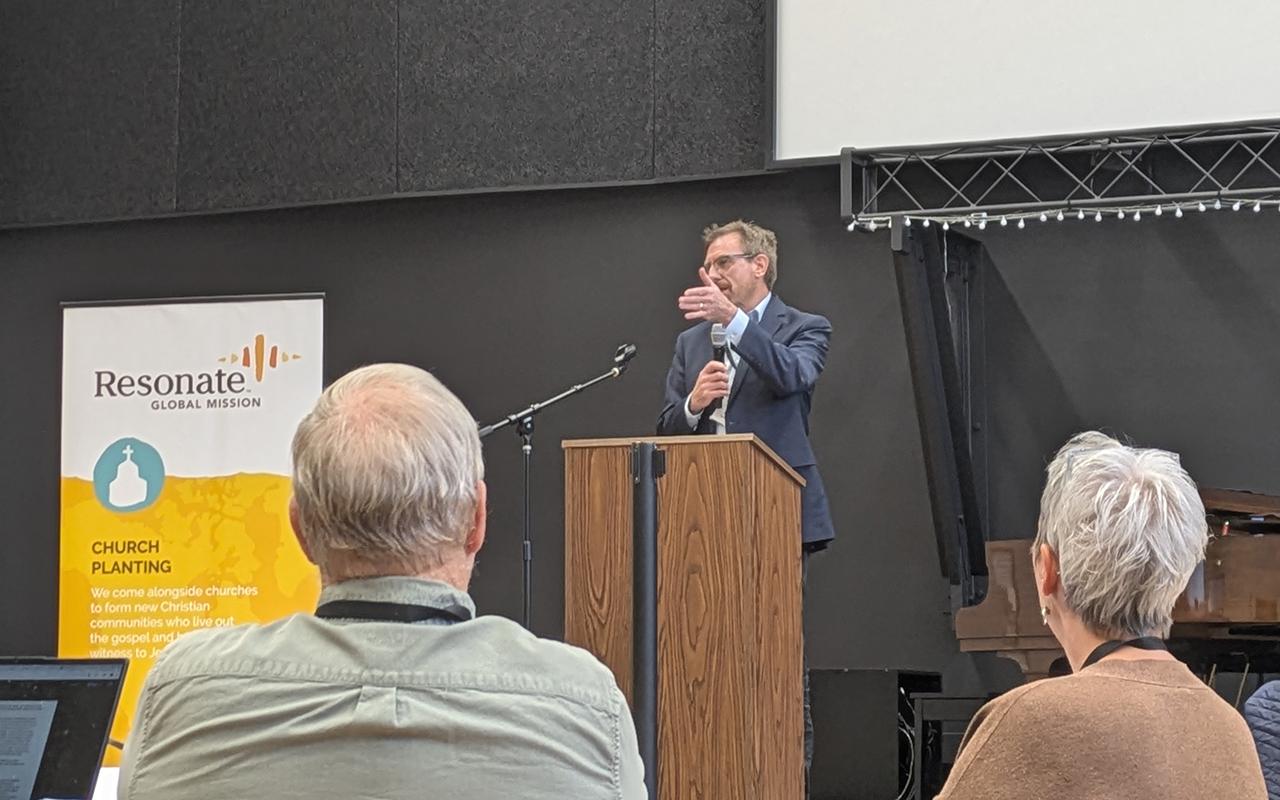
“Synod 2025 said we cannot stay where we are,” Resonate Global Mission director of church planting Rev. Tim Sheridan reminded the Council of Delegates as he presented the 10-year Strategic Plan for Church Planting for the Council’s endorsement at its May meeting. Synod asked for a plan, within a year, for “‘What are we going to do collectively as a family of congregations, agencies, and institutions?’ What we have now is an answer to that,” Sheridan said, asking delegates, “Does this hit the mark? Is it an adequate response to that mandate?”
After discussion, the 60-member ecclesiastical board, which works on behalf of synod in between meetings of synod, endorsed the plan “in concept.” It will be included in the supplemental agenda for synod (available later this month). Synod, the annual general assembly of the Christian Reformed Church in North America, will next meet June 12-18 in Grand Rapids, Mich.
Although the impetus for the plan was a request from Synod 2025, which itself was a continuation from a Synod 2023 decision “to develop a comprehensive unified strategy and plan to arrest and reverse the trend of decline and bring about a positive trend of membership growth to our denomination,” (Acts of Synod 2023, p. 976) Sheridan said it’s “not about saving this denomination or church growth. This is about the gospel.”
“The plan pushes us to one of the most critical questions we have to ask: Why should we plant churches? Because of the gospel—the good news announcement that God has broken into history, centered on King Jesus,” Sheridan said. “God’s purposes for the whole world are always meant to be embodied by people with the entirety of their lives. Resonate longs to see this good news saturated” in every thing we do.
10 Years in “5-year Measurable Slices”
The plan starts with what Sheridan called “the critical foundational work of prayer and fasting” and lays out five other strategic areas that will have to be prioritized to see a hoped-for 2031 outcome of establishing 150 new worshiping communities. The rationale is, “Ten years is a long time from now. To help us know that we are making progress towards this vision and to clarify what we need to do in order to get there, we need ‘vision with teeth’ for the next five years followed by a strategic ‘reset’ for the five years after that.”
IF: If every Classis in the CRCNA has a sustainable church multiplication pathway in place that helps local churches make disciples, develop leaders, equip planters, and plant new churches,
THEN: 150 new worshiping communities will be established across the U.S. and Canada by 2031.
—draft 10-year Strategic Plan for Church Planting in the CRCNA
“Think of the next five years as laying that foundation toward 2031,” Sheridan said. “What will it take for the ‘if’ to be true?” The plan suggests prioritizing discipleship multiplication; leadership development; church planting pathways; legacy stewardship; and funding and capacity development.
The strategic plan explains why these are the areas to prioritize; shares key insights from the groups that collaborated to develop the strategic plan; highlights opportunities among growing diversity of leaders and diaspora communities; names a mid-point milestone for each area; lays out specific recommendations for synod; and concludes with “a one-year mission-critical objective.”
Within 12 months, the CRCNA will have designed and aligned an ideal church plant journey, with clear ownership across denominational agencies, Classes, and congregations for each stage from disciple to leader to church planter to launch, along with a funding plan to support implementation.
—draft 10-year Strategic Plan for Church Planting in the CRCNA
Sheridan reiterated, “This is not top down. This is going to go by each one of us in this room, praying and fasting… we’ll be in your corner as you launch church plants and resource them.”
Reactions to the plan, shared by delegates around their tables and noted to the group by spokespeople, included appreciation that the starting point is the gospel truth, that annual accountability is built in, that the approach is “not therapeutic problem-solving but a long-term plan with short-term checkpoints,” and that it begins with an emphasis on prayer and discernment. Delegates had questions about whether any possible change to structure, such as the consolidation of some classes, would need to come first, “or can we do that all at once?” Are the performance indicators strong enough? And “how will this plan hit certain pockets of the denomination. What will people think when we’re talking church planting and building when some classes and churches are struggling?” Sheridan acknowledged that very real concern. “Part of me, quite frankly, when I think about the question of health and struggle, the response is, ‘Not now; churches aren’t ready.’ But I talked myself out of that,” Sheridan said. “This is what Synod 2025 asked for. We see the hurt, we see the pain. This is not us not paying attention. This is us trying to honor what synod asked for.”
To the question, “How will adopting this plan shape the CRC in the future?,” two responses shared from the tables of delegates stood out: "If we're honestly discipling everyone in our churches, it will change our whole culture” and “it is going to be either very encouraging or very discouraging, depending on how we execute.”
The Renewal Side of the Picture
Rev. Elaine May, presenting for the CRCNA’s Thrive ministry, told the Council of Delegates that agency also understands the concern about ‘maintenance mode’ mentality. “We understand this reality. Thrive is operating on two-thirds of what we were a few years ago. We are in it with you. We get it. We know it’s hard. We know the grief when someone retires who so influenced our culture. I think we need to get curious and say, ‘OK God, what are you doing?’ We don’t like it, but we believe you are at work.”
May showed delegates images of trees in various states of health, some mature with some dead branches, some slender with only parts showing new growth, and one a decaying log nurturing the growth of new trees. Saying they were metaphors for churches, May pointed out “thriving churches plant churches” and “thriving” does not mean perfect. A church at any stage can participate in God’s redeeming mission. “Who knows what God will do with a little bit of faithfulness,” May said.
“We believe God can make dry bones come alive. God can bring life from death. We are a resurrection people,” she said. “I have done it. I have disbanded and dissolved a congregation, and when we let go, God in his Spirit brought hope. Because then we could see what we had left to steward.”
May said, “Thrive can help as an objective outside party to support you(r churches) in courageously following Jesus. The life of a disciple requires courage, and it starts at the trailhead, ‘Thriving Essentials.’”
A written report on “Thrive's ongoing efforts to work with classes and churches to address membership decline and their efforts to coordinate these church renewal plans with the church-planting strategy being developed by Resonate” is also going to Synod 2026.
About the Author
Alissa Vernon is the news editor for The Banner.