
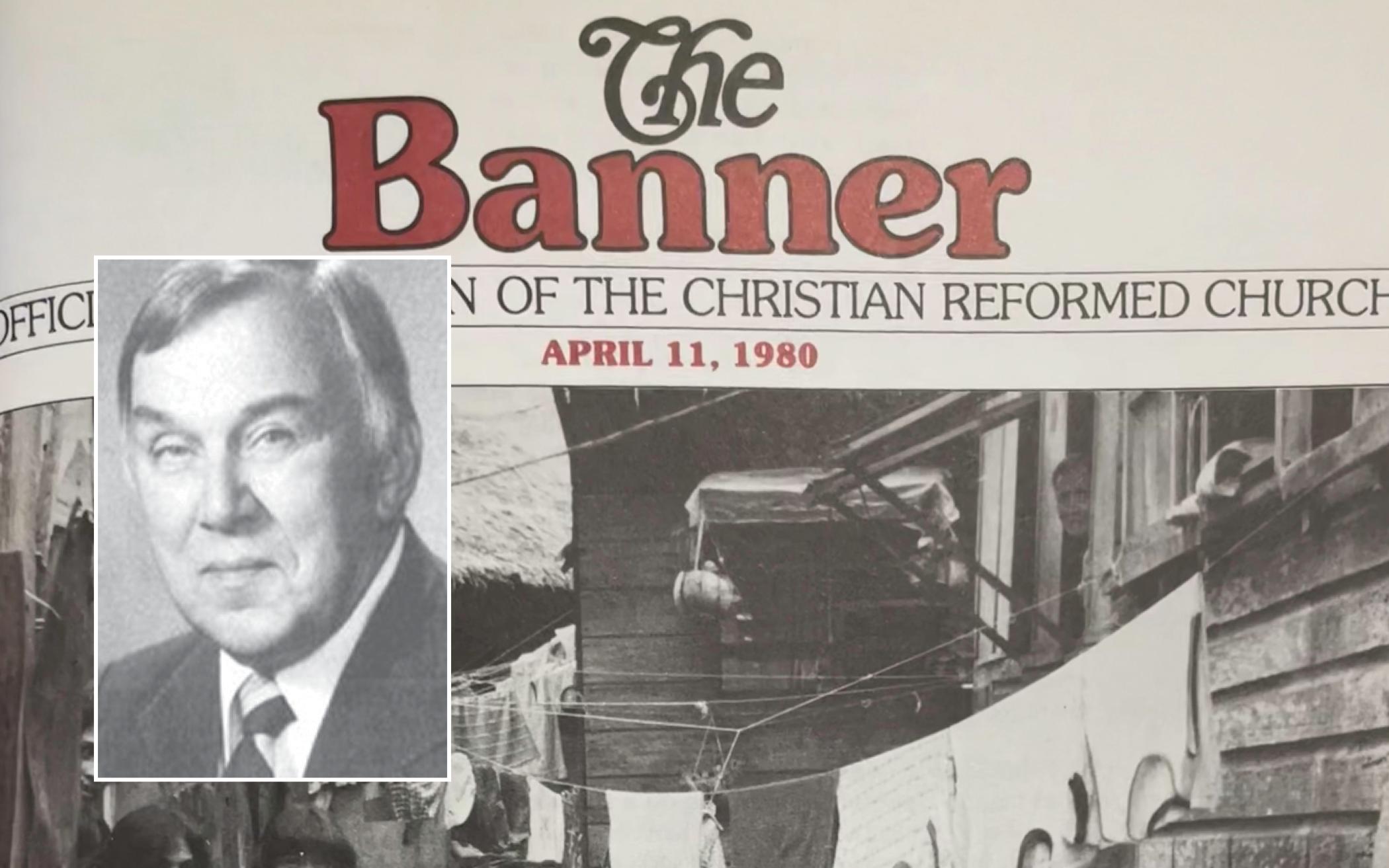
Note: This online-only article is part of a series showcasing past Banner editors. You can read all the content celebrating The Banner’s 160th anniversary here.
Lester DeKoster became editor of The Banner in 1970, the first non-ordained person to sit in the chair. In his first editorial, he wrote that he saw the Christian Reformed Church as a “strong unified, uniquely gifted part of the church universal. … Of our many precious strengths … unity is the first gift I’ll mention. Even our arguments presuppose our oneness.”
DeKoster’s entry in the CRC archives at Heritage Hall notes that he constantly emphasized that the strength of the Christian Reformed Church lay in the faithful preaching of the Word. “He cherished the confessions to which the Christian Reformed Church is dedicated and pointed out that respect for them and the Church Order would restrain experimentation in doctrine and practice. Repeatedly, he maintained that theology is not the first order of business for the Church. “Preaching the Word is the primary key to a well-ordered Church.”
As The Banner focused on wider cultural issues, DeKoster spoke out on communism and national defense, the welfare program, and the church’s responsibility to the poor. He expressed his views on the Middle East. He joined others in the defense of the unborn, opposing abortion.
DeKoster came under fierce criticism for running movie reviews in The Banner even though at the time the CRC’s official stance on “worldly amusements” condemned going to the movies. DeKoster defended on the ground that the church’s youth “needed expert guidance in their television viewing and movie attendance.”
That same historical entry noted that DeKoster showed remarkable restraint in the face of criticism that was, at times, cruel. Throughout the decade he practiced “a soft answer turneth away wrath” in both correspondence and editorials.
Gertrude Haan, writing in The Banner about editors she had known, noted that “to his friends he was unfailingly gracious, and he could charm even his opponents, and thus disarm them, when he chose.” She wrote that he would dash into the thorniest controversies, stir up the church, and thereafter handle a flood of voices, pro and con, with the greatest equanimity. “I think he enjoyed it,” she wrote.
Haan wrote that under DeKoster, the magazine became much more flexible, open to a greater variety of contributors. He changed it to a magazine that was open to a wide variety of cultural, devotional, and reflective material, as well as a wide variety of authors and opinions. “It made The Banner a far more lively and exciting magazine than it was when every week had largely the same departments and same writers year after year.”
DeKoster began his career as a public school teacher but made his way to becoming Calvin College’s library director and speech professor. As the library director, he oversaw the conversion to the Library of Congress classification system as well as greatly expanding the library’s holdings. A major accomplishment in his career was assembling a comprehensive collection of John Calvin and Calvinism material for the college.
He was a staunch advocate for church libraries.
In one of his last editorials for The Banner, DeKoster wrote that the purposes that had guided his work were to make the magazine a bulletin board for the denomination, to inspire, to stimulate, to alert the denomination to trends in the church and the world, and to build up the spiritual life of believers and their families.
That bears a remarkable resemblance to the Banner mandate that remains to this day.
About the Author
Gayla Postma retired as news editor for The Banner in 2020.