
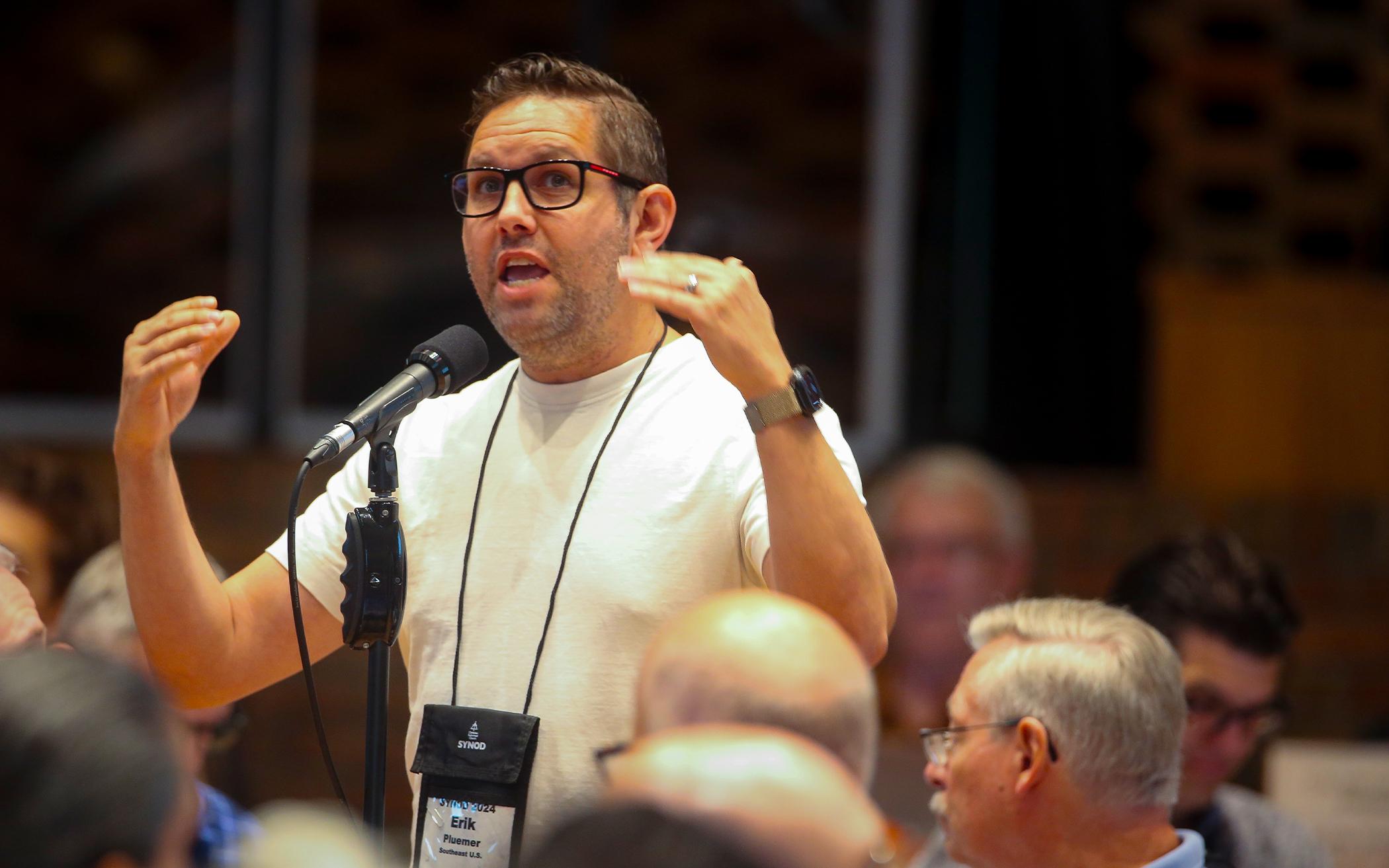
The report of a Task Force to Study Multisite Churches, to be presented to Synod 2026 of the Christian Reformed Church in North America, is now available online. The 18-page report with a three-page appendix will be included in the synod agenda. Requested by Synod 2024, in response to an overture from Classis Chicago South, it “aims to clarify how multisite ministries can be pursued in a manner consistent with Reformed polity.”
“Synod 2024 appointed this task force because multisite expressions are increasingly present within the CRCNA, yet our Church Order and synodical regulations do not explicitly envision these arrangements,” the report reads. Responding “with shared definitions, theological and ecclesiastical guidance, practical roadmaps, and a proposed Church Order supplement,” the report makes six recommendations, including that synod “encourage classes to recognize multisite expressions as a potential pathway for growth, revitalization, and church planting, and to cultivate a deeper sense of shared ownership for the health and mission of the churches within a classis.”
The multisite spectrum
The report defines six broad categories within the spectrum of multisite arrangements—from one church in many rooms, a church functioning “as a single congregation while utilizing multiple physical spaces at the same time,” to a church network or family of churches where networked congregations “share theology, vision, and often leadership development pipelines or ministry resources, but each congregation functions as a fully autonomous church.”
The factors involved in defining the multisite models, the report suggests, are as follows:
- Governance: whether authority is vested in a single council or leadership team or is distributed among multiple local councils.
- Budget: whether finances are unified across sites, managed locally, or structured through a hybrid model.
- Membership: whether there is one shared membership roll or multiple site-based memberships.
- Preaching: whether preaching is unified, shared across campuses, or independently developed at each site.
- Branding and identity: whether congregations operate under a single name and identity or maintain distinct local identities.
The task force observed “that within the Christian Reformed Church in North America there already exist examples of congregations operating across the full range of multisite expressions … experimenting with and embodying various ways of being the church in multiple places and forms.”
Related: Multisite Churches: One Ministry, Many Places, Some Challenges (May 11, 2018)
The report “articulates why multisite expressions matter for the current and future health of our denomination,” noting that the various expressions arise as a response to growth; extending ministry to new places; revitalizing dying congregations; planting for diversity and mission; and encouraging innovation and local creativity.
Local is Primary Expression of Church
The task force affirms that “the instituted local congregation—with its own council of ministers, elders, and deacons—remains the primary and ordinary expression of the church on earth.” Any “broader assemblies, denominational agencies, and shared structures exist to serve this local reality rather than to replace it.”
Cautioning that multisite arrangements must support and not work against this reality, the task force “notes that certain multisite arrangements risk unintentionally reversing the proper ecclesiastical order” and it offers safeguards:
- Emerging congregations should be understood as temporarily lacking local officebearers, not as permanently dependent communities (see Church Order, Art. 38-a).
- Elders providing oversight to emerging sites must be intentionally present and relationally engaged, not merely administratively responsible (Art. 25-b).
- Multisite structures should include clear pathways for leadership development and, where feasible, movement toward greater local governance.
The report includes a proposed Church Order supplement to Article 35, pertaining to the function of the church council, which lays out polity principles for multisite congregations. Covering forms of governance, classical oversight, representation in broader assemblies, and membership records and pastoral accountability, the supplement is “intended to provide clarity and ecclesiastical accountability while allowing appropriate flexibility for local discernment and missional context.”
Road Maps
The task force recommends “that synod instruct classes to work with new and existing multisite churches to provide a clear ministry plan to classis when forming or significantly restructuring a multisite arrangement” and provides an appendix and potential “road maps” that can be used to articulate that plan, which “should address, at minimum, how the worshiping communities will fulfill the marks of the true church in their context, including preaching, sacraments, discipline, pastoral care, and clear lines of accountability,” the task force said.
Across four different road maps—one each for for response to growth, extending ministry to new places, revitalizing dying congregations, and planting for diversity and mission—“the task force encourages churches to (1) name their intended multisite model on the spectrum; (2) clarify whether each worshiping community will be treated as organized or emerging; (3) specify how Word, sacrament, and discipline will be administered locally; and (4) ensure transparent relationships of governance, finances, and membership.”
Keeping Track
The task force also recommends that synod “direct the Office of General Secretary to develop and implement a method for collecting and reporting membership and leadership data by campus or worshiping community in multisite arrangements” and “encourage classes to ensure that emerging worshiping communities are appropriately recognized, supported, and—where consistent with classis rules and Church Order provisions—represented in broader assemblies.”
Pastors Derek Buikema, chair; Scott Vander Ploeg, reporter; Pedro Aviles; and Jonathan Kim served on the task force, along with two-time young adult representative to synod Samantha (Sebastia) Teran. Staff members Tim Sheridan from Resonate Global Mission; Joel Vande Werken, director of ecclesiastical governance; and Lesli van Milligan, director of Thrive, served as consultants.
Synod 2026, the annual general assembly of the Christian Reformed Church in North America, is meeting June 12-18 on the campus of Calvin University in Grand Rapids, Mich. Go to crcna.org/synod for the livestream, photos, reports, and a live blog of synod proceedings and decisions. Find daily news and our video Synod Recap at thebanner.org/synod.
About the Author
Alissa Vernon is the news editor for The Banner.