
The Banner has a subscription to republish articles from Religion News Service. This story combines two articles by Claire Giangravé, published Nov. 26 and Nov. 28, 2025 on religionnews.com. The combined article was edited for length and Banner style.
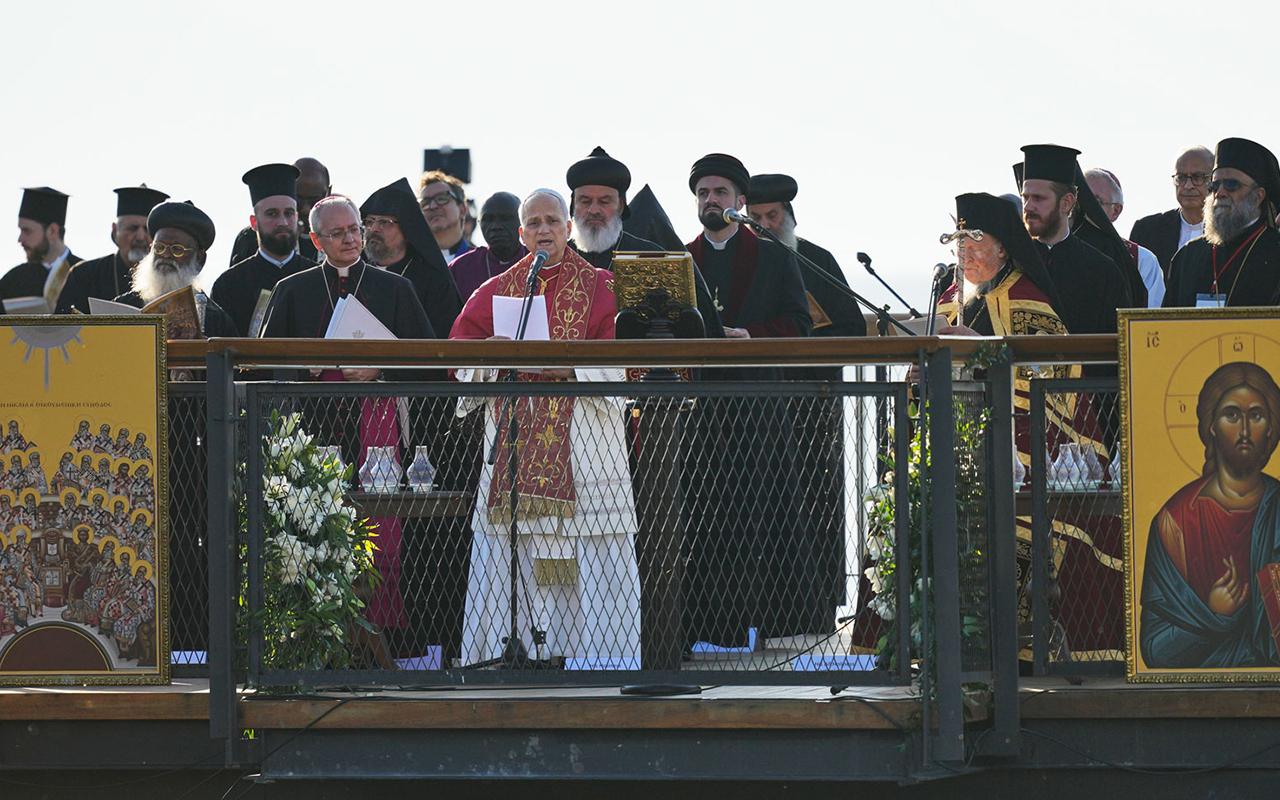
U.S.-born Pope Leo XIV on his first international trip as pope visited Turkey and Lebanon, with a stop in İznik, Turkey, on Nov. 28, commemorating the 1,700th anniversary of the Ecumenical Council of Nicaea.
The motto of the pope’s trip, “One Lord, One Faith, One Baptism,” reflects his intention to foster communion with Christian denominations across theological and liturgical differences. “The Council of Nicaea is not merely an event of the past but a compass that must continue to guide us towards the full visible unity of Christians,” Leo said in his address to the Nicaea symposium in Rome in June.
Not much remains of Nicaea—some 10,000 feet of broken walls, a few gates and the faint footprint of an imperial palace are scattered in the Turkish city of İznik. But what is now mostly rubble was the birthplace of the Nicene Creed—a statement of belief shared by almost all Christians today.
There, before the newly resurfaced ruins of the Basilica of Neophytos, buried until the last decade by the waters of Lake İznik, Pope Leo XIV joined with Patriarch Bartholomew of Constantinople and other Christian leaders.
Related: Celebrating the Nicene Creed (Feb. 10, 2025); Christians United in Song and Prayer in West Michigan (Feb. 21, 2025)
Bartholomew, who is largely recognized as the spiritual leader of Eastern Orthodoxy, spoke first, underlining that the event was not just a remembrance of things past, but also a reminder for the present.
“We return to this wellspring of the Christian faith in order to move forward. We refresh ourselves at these inspired waters of rest in order to become strong for the tasks that lie ahead. The power of this place does not reside in what passes away, but in what endures forever,” he said.
After an ecumenical prayer and the reading of the gospel, Leo observed that “at a period of history marked by many tragic signs, in which people are subjected to countless threats to their very dignity,” the Council of Nicaea offers an opportunity to deepen the faithful’s relationship with Christ, warning against the danger of reducing the figure of Jesus “to a kind of charismatic leader or superman.”
The pope said the anniversary offered a chance for Christians to deepen their bond to one another. “We are all invited to overcome the scandal of the divisions that unfortunately still exist and to nurture the desire for unity for which the Lord Jesus prayed and gave his life,” Leo said, adding that it could also inspire unity in a world “afflicted by violence and conflict.”
The pope also condemned any “use of religion for justifying war, violence or any form of fundamentalism or fanaticism.”
When the Council of Nicaea was convened in 325, the early church was facing internal divisions, with the Alexandrian priest Arius disputing the fully divine nature of Jesus. Constantine, the first Roman emperor to convert to Christianity and to legalize it with the edict of Milan in 313, wished to call all bishops from across the empire to settle the issues.
In Nicaea, the council established the fully divine nature of Jesus, set the rules for the celebration of Easter and wrote the Nicene Creed. Christianity eventually splintered into the multiple denominations that exist today, but the ecumenical council represents a first, and lasting, effort to ground the Christian faith in shared principles and beliefs.
The number of Christians in Turkey has declined significantly over the past century, dropping from 25% of the population in 1914 to roughly 0.4% today due to political instability, persecution and migration. The Muslim-majority country in practice recognizes only three non-Muslim minority communities: Greek Orthodox, Armenian Apostolic and Jewish. All other religious groups—including Catholics—lack full legal recognition and face significant obstacles to owning property, running schools or opening seminaries.
The Greek Orthodox Halki Seminary has been closed since 1971, and some in the country hope the papal visit will reignite conversations around opening it again.
“We are urged to be what we are supposed to be: to care for the church. Period,” said the Rev. Paolo Pugliese, superior of the Capuchin friars in Turkey, during an online conference. “We have many churches, many different denominations, and the blessing of weakness,” he added.
Pugliese explained that the delicate position of Christians in the country “opens a possibility for dialogue,” but relations among Christians vary greatly in Turkey. Catholic clergy in the country focus on establishing personal and informal relationships, he said.
c. 2025 Religion News Service
About the Author
Religion News Service is an independent, nonprofit and award-winning source of global news on religion, spirituality, culture and ethics.