
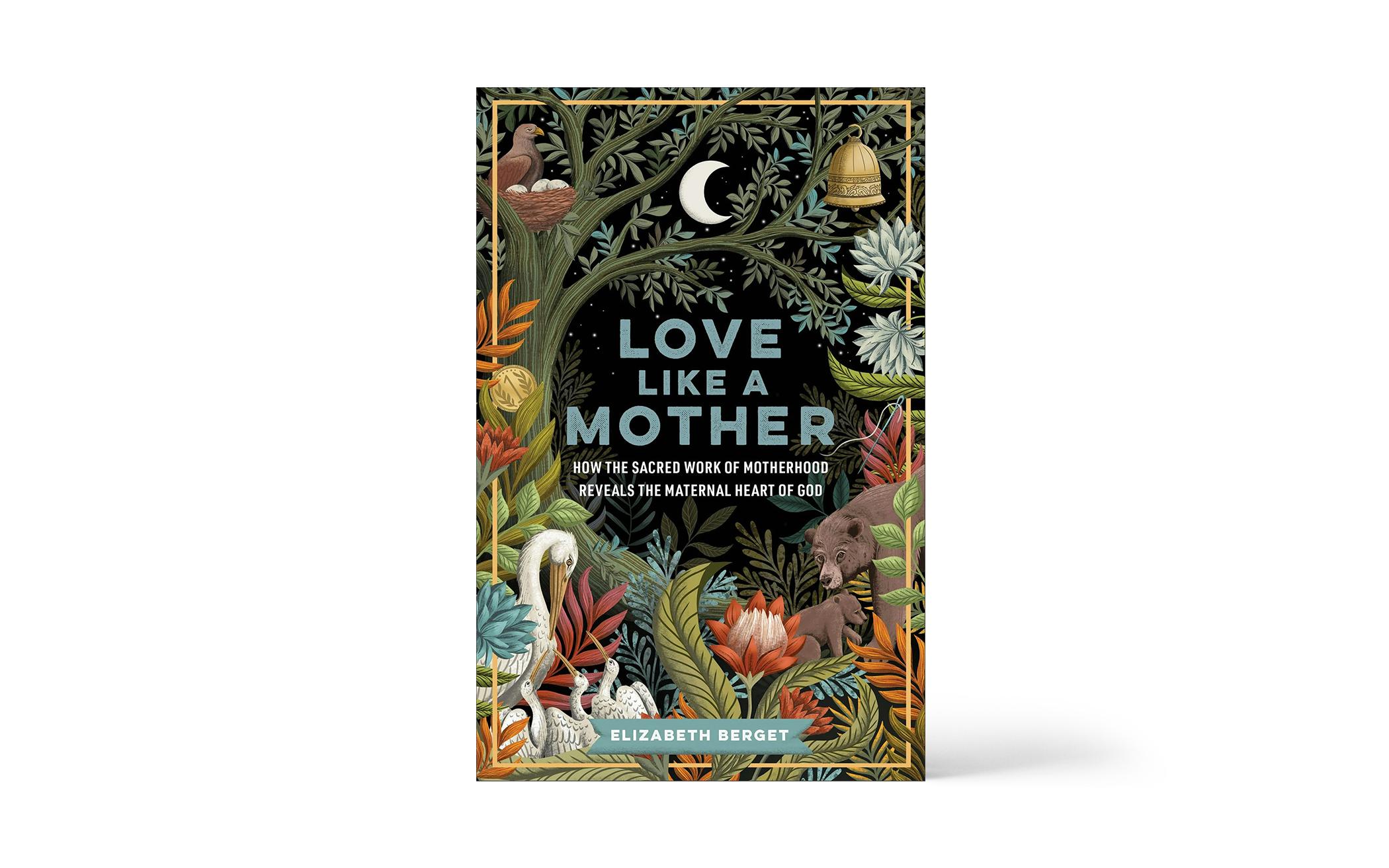
God is our father, and Scripture is woven through with masculine imagery to describe him. That is all wonderfully true, orthodox, and indisputable. But in this book, Elizabeth Berget gently leads readers to discover a God who also made mothers in his image and who nourishes, comforts, and protects us like mothers do. Mothers bear his image and show us what God is like when they nurture us like he does.
Berget quotes conservative theologian John Piper at the outset to state a neglected truth: “God is not male. … From eternity, God has not had a body—a physical body—and therefore he doesn’t have male features. … ‘Male’ is a biological word, and God is not a biological being.”
Throughout the pages of Love Like a Mother, God as father is honored and revered—nothing is taken away from that beautiful doctrine. This book is wholly fixed in the historical Christian tradition. But Berget also expands and broadens our understanding of God’s tender, gentle characteristics as well as his fiercely protective side.
She highlights a God of deep compassion as revealed in Exodus 34:6. “The first self-referencing descriptor God uses is compassionate,” she writes. “The word used is rakhum, and it has its roots in the Hebrew word for womb (rekhem), which indicates that the compassion of God, the rakhum of God, is a womb-born, deeply emotional love that time and time again moves God to act on behalf of his children.”
I was fascinated with how many times the Bible uses birth imagery to describe the God who birthed us into being and also into new life in him:
- Psalm 90:2: “Before the mountains were born or you brought forth the whole world, from everlasting to everlasting you are God.”
- Deuteronomy 32:18: “You deserted the Rock who fathered you; you forgot the God who gave you birth.”
- Isaiah 42: 13-14: “The Lord goes forth like a soldier … I will cry out like a woman in labor. I will gasp and pant.” (A soldier and a woman in labor depict different facets of God in the same text.)
We are born of God and then hand-raised by him. From the time God tenderly stitched clothing for Adam and Eve to wear in their nakedness, he shows us his gentle, loving care.
Readers will feel loved by God as Berget highlights imagery such as that in Hosea 11:3-4:
“Yet it was I who taught Ephraim to walk; I took them up in my arms,
But they did not know I healed them.
I led them with cords of human kindness
With bands of love
I was to them like those who lift infants to their cheeks, I bent down and fed them.”
Berget, the mother of two school-age children, writes this book to encourage mothers of all ages as they endlessly tend to the needs of their children. A gorgeous writer, and, even better, a funny one, she artfully weaves in many stories of motherhood and its joys and challenges. As an adoptee and adoptive mother, I love how she spends a good amount of time speaking to foster and adoptive mothers, comparing the process of building bonds of attachment with a child to how God “enters into the long slow work of securing our attachment.”
Berget reminds readers that God “gently leads those that have young” (Is. 40:11) as he models a love that is affectionate, watchful, and ever sacrificial. (The book’s cover art depicts various imagery of God, including mother eagles, bears, and pelicans. The latter are not in Scripture but appear countless times in medieval Christian iconography, showing a mother pelican wounding her own breast with her beak to feed her young with her blood, symbolizing Jesus Christ's sacrifice.)
This book would bless and bolster any Christian mother longing for encouragement and strength in the daily work of motherhood. Even though my children are all college aged or older, its message deeply resonated with me. As I thought about the children of a friend of mine who died, it struck me that these pages would also be comforting for those who have lost their mothers or who are estranged from them. Berget also addresses infertility, miscarriage, and child loss here in a way that will touch and console readers.
I was sad to end this book, marked up with myriad notes and highlights. But the message lingers: One Sunday morning, I observed a 50-year-old church member cradling the baby of her friend who was up on the podium, leading the children's church. This church mother shifted the baby this way and that, rubbing her back, stroking her head, until at last the little one succumbed to these maternal ministrations and nestled in for a nap. And maybe for the first time ever when witnessing such a scene, I thought about God, my father in Heaven, who also gently mothers me and all his beloved children. (Baker Brazos)
About the Author
Lorilee Craker, a native of Winnipeg, Man., lives in Grand Rapids, Mich. The author of 16 books, she is the Mixed Media editor of The Banner. Her latest book is called Eat Like a Heroine: Nourish and Flourish With Bookish Stars From Anne of Green Gables to Zora Neale Hurston.