
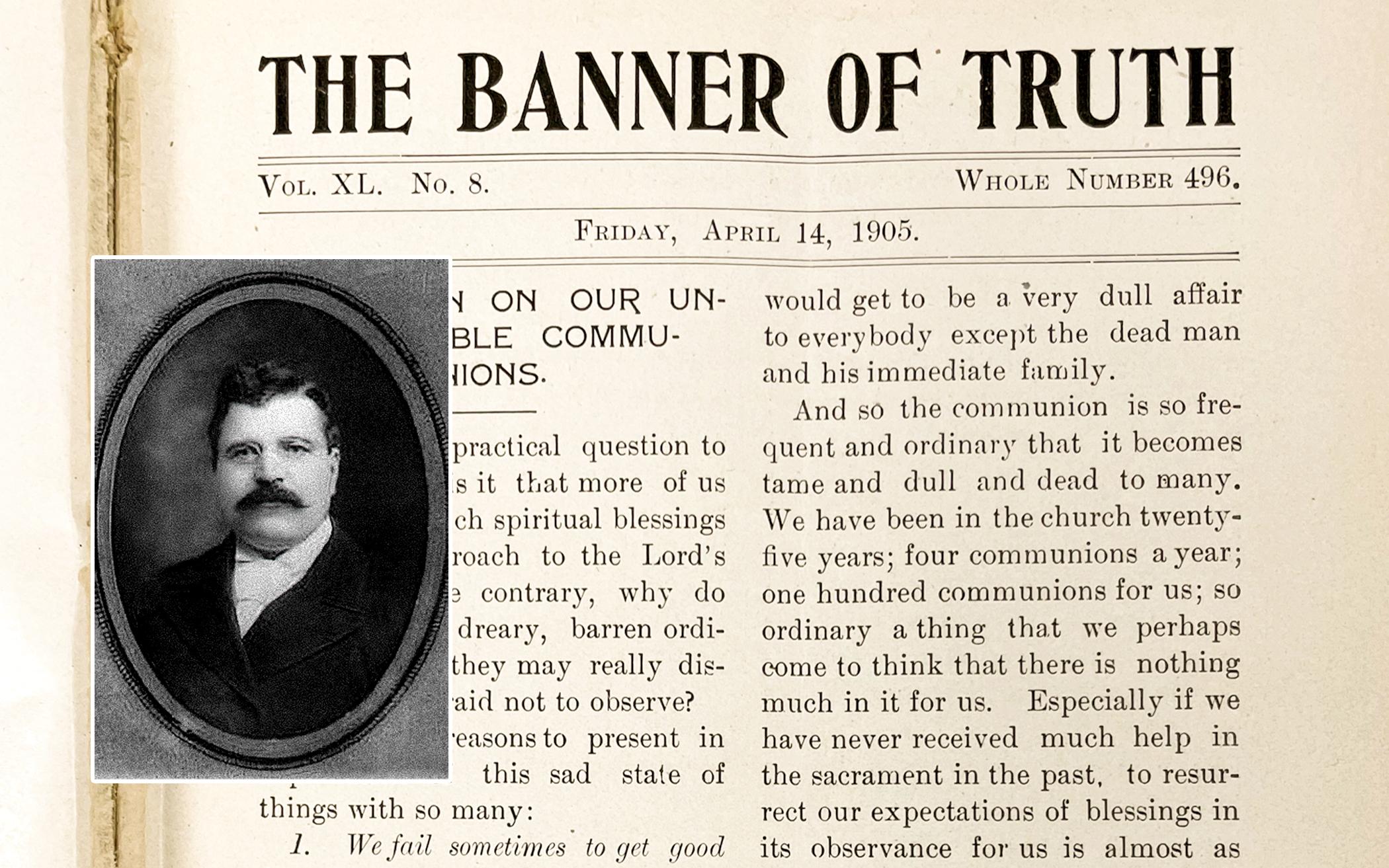
Note: This online-only article is part of a series showcasing past Banner editors. You can read all the content celebrating The Banner’s 160th anniversary here.
Rev. Henry Beets headed the group that purchased The Banner and in 1903 took the editor’s seat where he served for 25 years. Because Beets took over the Christian Reformed Church’s magazine at the time it was purchased, he is sometimes referred to as The Banner’s founding editor. But that honor goes to Rev. John De Baun.
In Origins, a magazine about CRC history, historian H.J. Brinks wrote that Beets immigrated from the Netherlands to Luctor, Kans., in 1886, where he was mentored by men from the Reformed Church in America and the Christian Reformed Church. He became an ordained CRC minister in 1895 and ardently defended the CRC’s 1857 secession from the RCA but also regarded eventual reunification of the two denominations as obligatory and almost inevitable.
When Beets moved to Grand Rapids, Mich., in 1899, he became pastor of LaGrave Avenue Christian Reformed Church. Brinks wrote that he already had a reputation as a clear-thinking Dutch-language writer, but he accepted the LaGrave Avenue pastorate, a congregation organized to satisfy the demands for use of English in worship. After he began to edit The Banner in 1903, he almost automatically became a leading advocate of English use in the CRC.
By 1914 the circulation of The Banner had grown to about 3,000 subscribers. That year The Banner became the official English-language publication of the Christian Reformed Church alongside the Dutch language De Wachter. When Beets retired as editor in 1928, subscriptions nearly equaled that of De Wachter.
“(He) was especially concerned until about 1920 to educate the CRC by reviewing its Reformed and Calvinist tradition. … Beets hoped to create a Dutch/American cultural fusion,” Brinks wrote in “Burning Shoes and Banana Peels: 125 Years of Banner.”
But the 1920s were a watershed decade for Beets and the CRC, wrote Brinks. Several major debates—Dutch versus English language, establishing a church-owned liberal arts college, adopting individual cups for commemorating the Lord’s Supper, and the endorsement of hymn- singing in worship—beset the church.
The CRC turned toward the main channels of American religious culture, concerning itself with worldly amusements, Darwinian evolution, and opposition to theological modernism. Writing for The Banner, Brinks said Beets sought to turn the denomination's attention outward toward foreign missions. That more positive endeavor, he hoped, would direct the community away from its internal conflicts.
“The growing popularity of missionary activity … led to a growing ecumenical cooperation with other church groups and missionary cohorts at work in Nigeria, New Mexico, and China. Beets flourished amid these expanding endeavors, and he became the CRC’s leading advocate. After he became director of Missions in 1920, CRC's Publication Committee discussed the possibility that Beets might be too busy to carry on as Banner editor, but they did not force the issue until 1924, a year when the denomination was heavily beset by controversy. The CRC’s Publications Committee did not nominate Beets as continuing editor because they said he had not provided forceful editorial leadership. True enough, Beets attempted to avoid partisanship and taking sides in the theological debates. Nonetheless Synod 1924 refused to follow the Publications Committee's recommendation. So Beets remained at his editorial desk until 1928” (H.J. Brinks, Origins).
After he was released from The Banner's weekly deadline schedules in 1929, Beets visited the CRC’s American Indian mission in New Mexico as his first major stop on his way to China, the Dutch East Indies, and Ceylon, now Sri Lanka. He returned via Egypt, Italy, Geneva, and the Netherlands.
Beets continued to publicize and promote missionary activity in his missionary monthly columns and as a feature writer for The Banner. These articles were usually fueled by Beets’ visits to and correspondence with the CRC’s missionaries around the world.
The 1925 organization of the CRC Women's Missionary Union in Beets’ LaGrave Avenue parsonage became a major vehicle for the promotion of missionary work. A similar group, the Christian Reformed Ladies Missionary Union, took shape in Chicago that same year. Beets nourished these organizations enthusiastically and became a virtual fixture at their National conventions (H.J. Brinks, Origins).
Beets served for 40 years as the denomination's first stated clerk. He also served as a member of a joint committee to revise the metrical versions of the Psalms for which he was awarded an honorary doctorate of letters by Muskingum College. In 1934 he was knighted by Queen Wilhelmina of the Netherlands and awarded the Order of O’Henry. Later he became editor and publisher of the Reformed Review and De Heidenwereld (Missionary Monthly). He published a number of pamphlets and books (Heritage Hall CRC archives).
Brinks wrote that although Beets’ tenure as Banner editor was shorter than his predecessor or his successor, he was a man for all seasons during 52 years of service to the Christian Reformed Church. “Henry Beets controlled, created, or influenced virtually every denominational institution,” he wrote. “No one was better known within the church, and no one represented it more authoritatively beyond its institutional borders” (H.J. Brinks, Origins).
About the Author
Gayla Postma retired as news editor for The Banner in 2020.