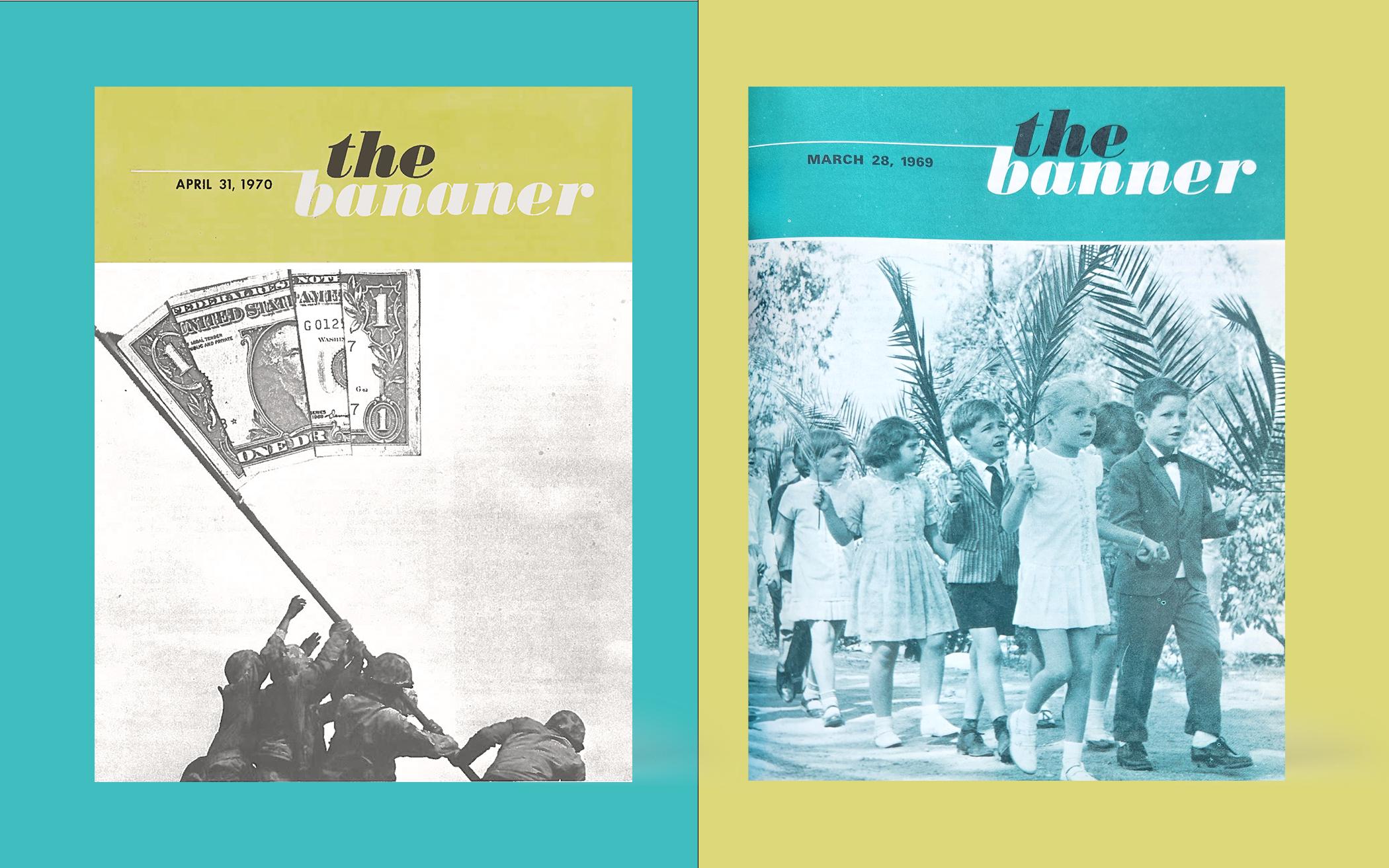
Any celebration of The Banner’s birthday has to include a story about The Bananer, even though it is 56 years old and appeared when the magazine had only recently turned 100. It’s hard to imagine now that a spoof of The Banner would cause threats of university expulsion, even excommunication, for its authors.
Looking back now, the reaction (overreaction?) to The Bananer provides a window into a time in the denomination when Christian Reformed congregations were so uniform in practice that when my family went on vacation, we could find the nearest CRC and feel right at home with the identical liturgy.
I remember when Christian Reformed traditions were treated as almost biblical commands, when in many families Sunday reading was limited to the Bible and The Banner, and Sundays meant no riding bikes or swimming or watching TV. Attendance at evening services was mandatory, as was catechism, Sunday school, Calvinettes (or Cadets), and Christian day school. “The Banner effectively mirrored the cultural life of the CRC,” wrote Herbert Brinks in the 1991 article, “Burning Shoes and Banana Peels: 125 Years of the Banner.
The Banner’s editor was revered.
In that setting, a satire of the CRC's beloved publication created a scandal in the CRC of epic proportions. Former Banner interim editor Leonard Vander Zee called it a watershed moment for the church.
The Bananer
It was May 1970 when The Bananer surreptitiously appeared around the Calvin College campus. Calvin seniors Luke Reinsma and Stephen Sieberson duplicated The Banner right down to the layout, the fonts used, and lampooning the columns that appeared in the weekly magazine.
The masthead identified The Bananer as the dilapidated calliope of the Philistine Rewarmed Crutch, published in Bland Rapids, Mich., edited by Rev. John Vander Phlegm, with a yearly subscription fee of one pair of wooden shoes.
In that week’s edition, editor Vander Phlegm wrote an open letter to all Philistine Rewarmed Crutch members who had fallen into the slothful habit of swimming on Sundays, noting that attendance at Sunday evening services suffered due to those who did not desire to attend with wet hair.
Its pages hosted a theological debate of whether two angels can dance on the head of a pin. The answer had to be no because good angels, like good Philistines, do not dance.
Perhaps most egregious was a feature article about a girl from Oostburg, Wisc., who skipped catechism to go to the movies with her boyfriend to see 101 Dalmatians. After he kissed her on the cheek, she woke up the next morning nine months pregnant.
Though the authors did not sign their work, they surreptitiously identified themselves in the obituaries as Siebs Chuckleson, who died of a heart attack in a confrontation with Rev. Vander Phlegm, and Laurence Reinson, who died of severe burns on his entire body, presumably from being raked over the coals.
The Reaction
Banner editor Rev. John Vander Ploeg was enraged. He wrote a four-page Banner editorial entitled “Do We Just Laugh This Off?” Calvin president William Spoelhof wrote a letter to the editor suggesting that the editor had overreacted.
Sieberson and Reinsma faced grave consequences that they spoke about when they returned to Calvin College for their class’s 40th reunion in 2010. Sieberson said they survived a proposal to expel them by one vote.
That summer, Spoelhof dragged Sieberson to his office to show him a thigh-high stack of letters. “Because of you I’m going to have to spend my summer answering these letters,” he said.
“Because of you, this will be the death of Calvin College, and you’re going to drive me to an early grave.” Spoelhof lived to the age of 98, and Calvin still exists.
In Seattle, Reinsma was called before the consistory and threatened with excommunication. One of the elders called The Bananer religious pornography. “About a year later, my dad finally spoke to me again,” he said.
James Schaap wrote that The Bananer succeeded in doing what it attempted only because The Banner itself was so greatly loved. “Everyone knew The Banner, and everyone got the joke. Many didn’t laugh.” He saw it as a time when “the late ’60s crashed headlong into my parents’ blessed denominational culture. Things would never be the same.”
Brinks called The Bananer the most successful satire the CRC has ever generated. “The spoof outraged a host of readers who considered the parody an attack on venerability of every sort. Others laughed—and laughed again,” he wrote. “For all its unpleasant embarrassments, The Bananer taught the lesson it intended.”
Both Reinsma and Sieberson eventually left the CRC, Sieberson to an Episcopal Church and Reinsma to a Presbyterian church.
Sieberson became a lawyer focusing on international business law and then a law professor at Creighton University in Omaha, Neb. According to his website, he is still working part-time at age 75 and has written three books, the latest based on his childhood in Sioux Center, titled The Fifteenth Commandment.
Reinsma retired in 2014 after almost 30 years teaching at Seattle Pacific University. He was recognized by faculty and students as an outstanding teacher and received the Carnegie Foundation Professor of the Year award. Students lauded his passion for literature and his generosity of spirit toward his students. One wrote that “Dr. Reinsma is the wisest teacher I have ever encountered. One source of this great wisdom is his humility.”
Neither ever heard from or talked to Banner editor John Vander Ploeg.
About the Author
Gayla Postma retired as news editor for The Banner in 2020.