
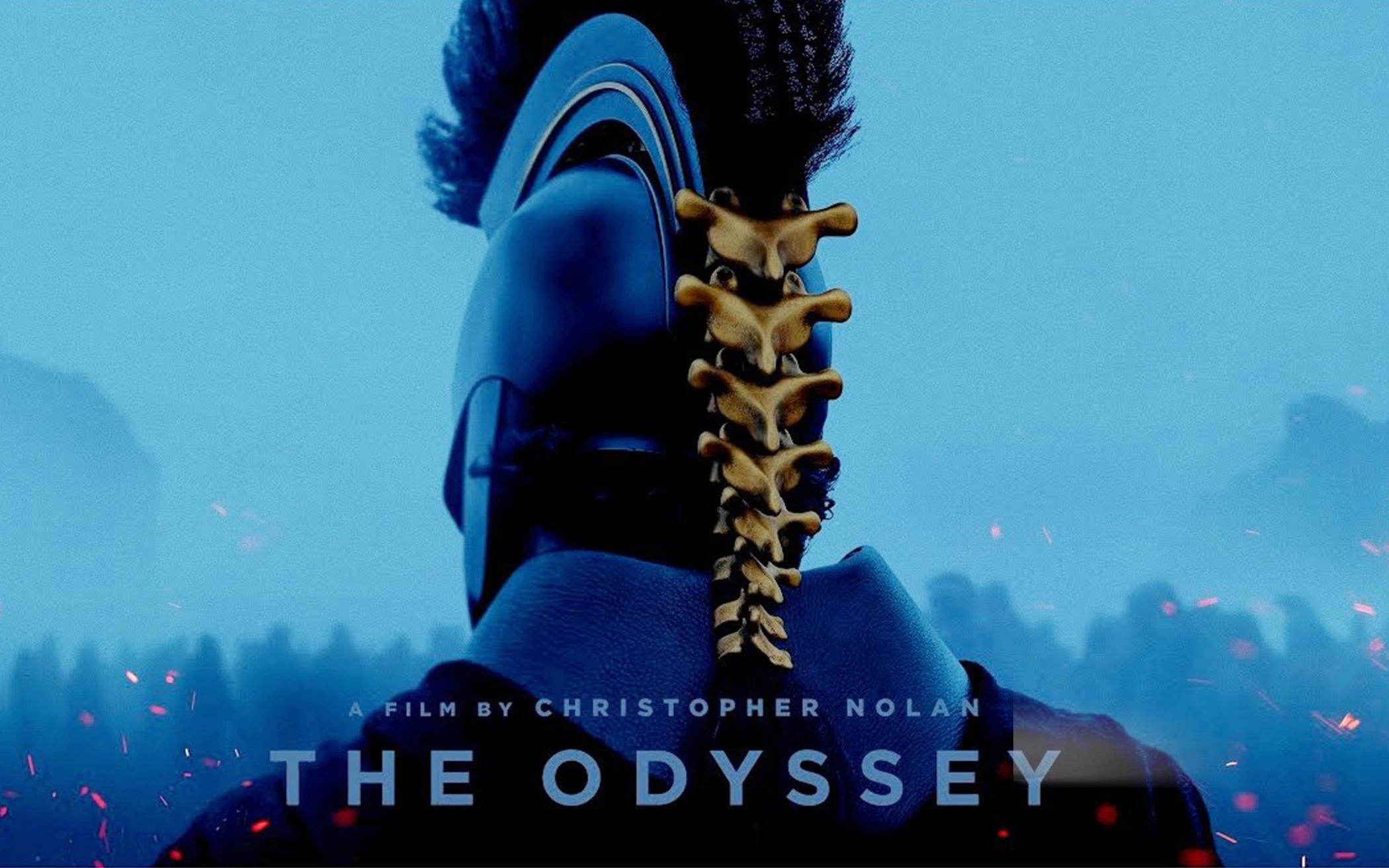
From the first drum beats of Bronze Age percussion in Christopher Nolan’s The Odyssey, moviegoers know they have entered an ancient and otherworldly dimension. The score, by Ludwig Göransson, feels different than any other score; its instruments are replicas of those depicted in Greek and Roman art. Had the filmmakers scored the movie with modern instruments, it would have felt all wrong.
As it is, the odd and jarring music sets the tone for a story that is odd and jarring, inspiring and disturbing, captivating and brash.
(I recommend looking up a synopsis of Homer’s book before going in; it would have saved me some confusion.)
The basics are this: Penelope (Anne Hathaway), queen of Ithaca, lives out her days in a dark palace, pining for her lost love, Odysseus, the king who left 20 years ago on a military mission to conquer Troy and never returned. Her strongest ally is her devoted son, Telemachus (Tom Holland), who helps her stay strong amid the encroaching threat of her myriad of “suitors,” who don’t come bearing flowers and chocolates but are literally camped out outside her chambers, carousing and drinking on her dime. The creepiest of the lot is Antinous (a very effective Robert Pattinson), who seems to embody evil itself even as he gets closer to the vulnerable Penelope. How long can she hold out before she caves in to one of them and Ithaca has a new king?
Amid this den of iniquity is also a surprising commitment to hospitality, as Telemachus and Penelope host beggars and others who need food and shelter, following “Zeus’ law,” in a way that will remind Christian viewers of Jesus’ command to welcome the foreigner and the stranger.
But where, oh where, is Odysseus, king of Ithaca (Matt Damon)? He is living a strange existence on a deserted island, drugged by the beautiful nymph Calypso (Charlize Theron). These scenes could have been gratuitous, but they are not, even though the moviegoer senses the two are lovers. When his memory returns, Odysseus only wants to get back to Penelope.
Flashbacks to the battle of Troy haunt him as he regrets the murder and plunder of his fellow humans. Critics have noted that the book’s Odysseus had no such qualms about it.
There is a surprisingly strong moral center to the movie, with Odysseus and Penelope being faithful to each other (for him, he was at least consciously faithful), the giving of hospitality, and the real consequences to wanton destruction. Homer didn’t think of it as sin, yet “the wages of sin” were real as depicted in Nolan’s movie version. Evil is not glorified but examined and regretted.
This moral center helps when all hell breaks loose in several scenes. Two scenes stand out: When the cyclops (the stuff of nightmares) chews loudly on his human snacks (the sound engineers were disgustingly brilliant here), and when the witch Circe (Samantha Morton) turns a bunch of possibly rapacious soldiers into pigs.
I admit I covered my eyes through some of it and was glad to escape to the bathroom. It’s a long movie, nearly three hours, and I walked out feeling like I just got off a roller coaster: exhilarated and a little bit ill.
I’m glad I saw it. The Odyssey is a piece of literature that has stood the test of time for 3,000 years, with its themes of homecoming, hospitality, and loyalty. (Though those who have read the source material have complained loudly about the off-book changes.)
It gave me insight into Scripture, helping me better understand the ancient world in which the biblical characters lived—a world swirling with competing gods, myths, and pagan rituals.
Hathaway runs away with the film, even though her role is much quieter than Damon’s. Her fidelity and love for her husband and son are the beating and broken heart of the movie.
This is definitely a film for mature audiences. It earns its R rating with violence alone, although there is a bit of strong language and some mild sensuality. Viewers will have to decide if they can handle the violence (and cartilage crunching noises). For me, it was worth it, if only to be reminded again that faithful love does conquer all. (In theaters now.)
About the Author
Lorilee Craker, a native of Winnipeg, Man., lives in Grand Rapids, Mich. The author of 16 books, she is the Mixed Media editor of The Banner. Her latest book is called Eat Like a Heroine: Nourish and Flourish With Bookish Stars From Anne of Green Gables to Zora Neale Hurston.