
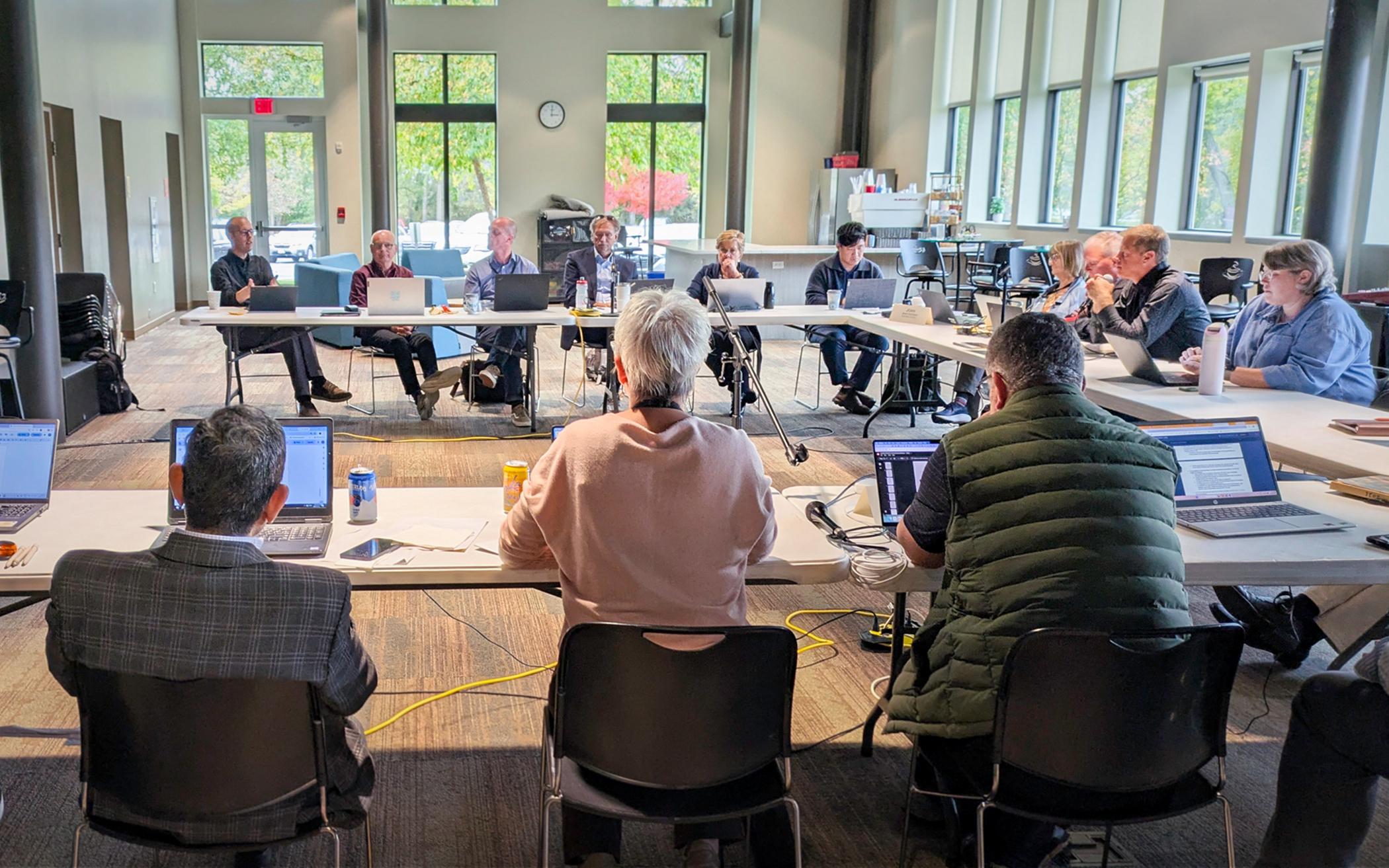
The directors of the Canadian Ministry Board, the operational governance board for ministry among the Christian Reformed churches in Canada, adopted refreshed mandates for Indigenous Ministry, Intercultural Ministry, and the Centre for Public Dialogue at their October meeting. The changes, worked out over the past eight months with input from ministry staff, outline tasks, accountability, and governance for each ministry and come into immediate effect.
Questions about the ministries’ mandates, how their connected support committees are appointed, and how they relate to the Ministry Board came up at the February 2026 meeting, prompted by correspondence from a church member. From that discussion the board appointed a subcommittee to review the mandates.
“Over the past several months, the committee met multiple times to do this work, including a lengthy session with staff leaders from each ministry,” read the subcommittee’s report. “These conversations gave the committee a fuller picture of each ministry's purpose, history, and day-to-day composition.”
That input, including “the strengths of their current mandates and the places where clarity has been missing, particularly around reporting lines and how each ministry draws on outside support and advice,” shaped the revised mandates presented to the board.
Each lays out “what’s the focus of this ministry, and the work it’s going to do, and where does the accountability lie?” said Lee Himbeault, Classis Alberta South/Saskatchewan, who served on the subcommittee.
In the refreshed mandates, each ministry is identified as “part of the Canadian Ministries Office of the CRCNA” and is accountable to the Canadian Ministry Board through the office of the executive director.
For individualized committees behind each ministry, “the executive director, in consultation with senior staff, shall determine if a committee to offer advice and support is needed for this ministry and shall define its role and its composition. The executive director shall communicate such decisions to the Canadian Ministry Board for information.”
There are currently committees in place for Indigenous Ministry and Intercultural Ministry. The committee for contact with the government, the first of these Canadian Justice Ministries, originally formed in 1968 and operationalized into the Centre for Public Dialogue, has been idle while the CPD has remained unstaffed after the departure of former director Mike Hogeterp in 2023.
The 2011 synodical mandate of the Centre for Public Dialogue, with minor updates to reflect organizational and contextual changes, served as the template for each of the refreshed mandates now adopted by the Canadian Ministry Board. Except for the specific tasks assigned to each ministry, the processes for reporting, accountability, and shaping of support committees are the same.
Al Postma, executive director, is responsible for providing regular updates to the Canadian Ministry Board on the work of the three ministries and bringing their proposed budgets and annual plans for awareness, amendment, and approval. He said the changes are more about “the governance underneath” the ministries—the footings—“but operationally it shouldn’t change things.”
The refreshed mandates will be posted on the ministry websites: Indigenous Ministry, Intercultural Ministry, and Centre for Public Dialogue.
Indigenous Ministry currently includes the senior leader for Indigenous justice and reconciliation, Adrian Jacobs; the national Canadian Indigenous Ministry Committee; and three urban ministry centers that operate as partners. “Grant funding &staffing of the director positions in each of three urban Indigenous ministry centers in Winnipeg, Manitoba; Regina, Saskatchewan; and Edmonton, Alberta” remains one of the three pillars of Indigenous Ministry. Creating and maintaining joint ministry agreements that help fulfill the Indigenous Ministry mandate with those partners is one of the specific responsibilities outlined in the Indigenous Ministry mandate.
Intercultural Ministry in Canada has two people currently sharing the senior leader position. Sebastian Maldonado, a campus minister in Toronto, and Jeremiah Bašurić, a pastor in Alberta, were hired in November 2024.
Postma said now that the mandate has been refreshed and the responsibilities are clear, he will begin work on fulfilling the expectations for the work of the Center for Public Dialogue. He doesn’t have a timeline for when staff may be hired. The first of five tasks specified for that ministry is written thus:
“Through the office of the executive director of Canadian ministries, recommend to the Canada-Corp Canadian Ministry Board how the Christian Reformed Church within Canada may effectively address all relevant levels of Canadian government on significant and pressing issues of the day from an integrally biblical, theological, and confessional perspective, expressed in terms of a Reformed worldview, emphasizing wherever possible the official positions of the CRCNA as determined by synod. Such recommendations will ordinarily be detailed in an annual plan and may include:
a. proposed position papers, briefs, and submissions to appropriate levels of government.
b. proposed strategies for communicating with the congregations on significant and pressing issues of the day.
c. proposed strategies for communicating with the government and the congregations on significant and pressing issues for which positions have been developed.”