
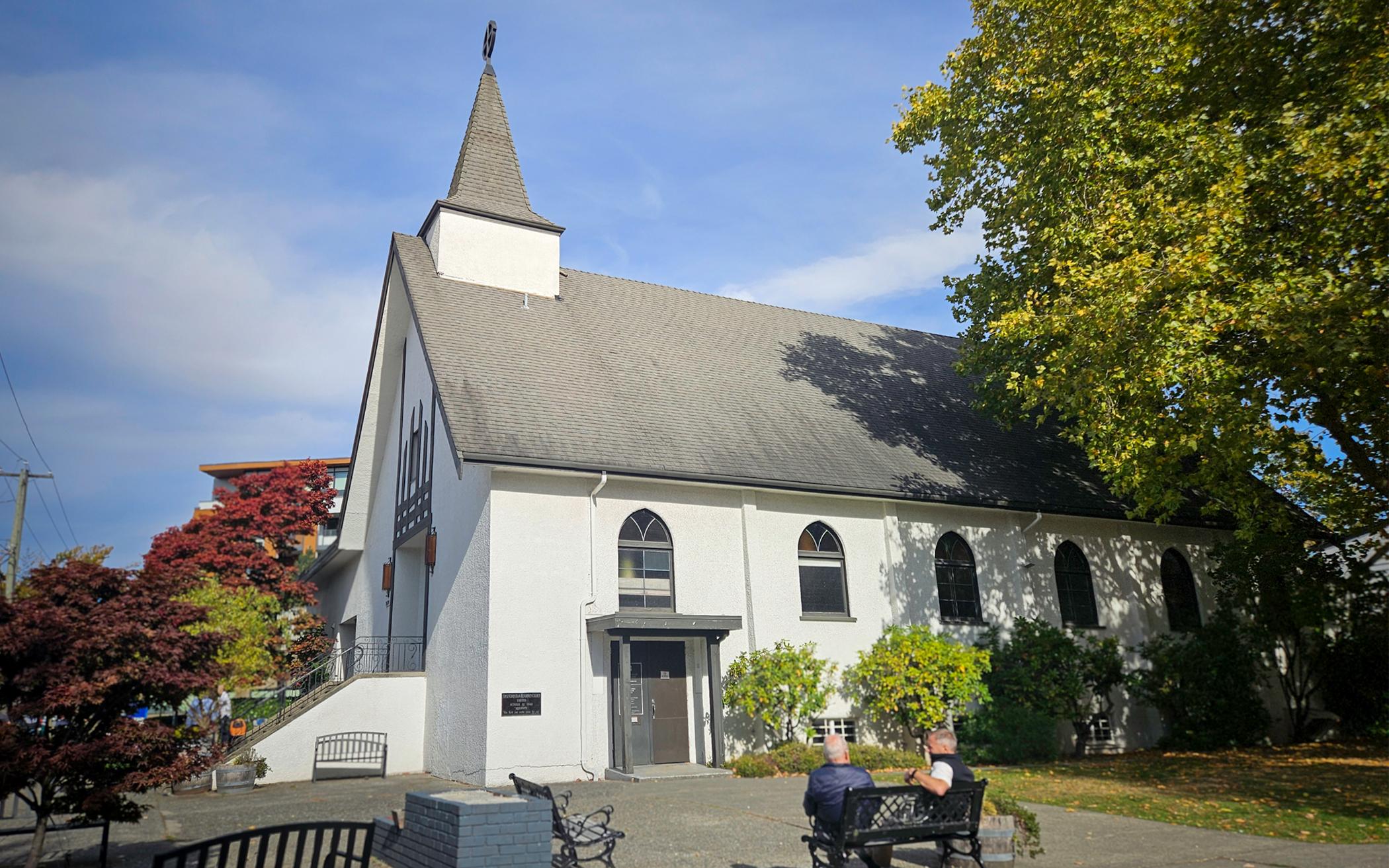
A white, steepled church stands as a landmark on Victoria Drive in Vancouver’s Eastside. It is home to the First Christian Reformed Church of Vancouver. The congregation marked its Centennial year with a celebration service on Oct. 18. One hundred years earlier, on Oct. 21, 1926, a small group of post-WWI immigrants formed the first CRC congregation in British Columbia. The cornerstone on an exterior wall marks the congregation's move in 1948 to its current location. The words “Rehoboth” and “The Lord has made room for us” (Gen. 26:22) have defined their 100-year presence in B.C.’s largest city.
The worship service honored the history of God’s faithfulness as well as the church’s place in the community. In giving the greeting, Pastor Trevor Vanderveen was joined by Priest Kassahun Asrat of the Ethiopian Orthodox church, who also gave words of welcome. The Orthodox church and a Korean Presbyterian congregation worship in the building. Song selections spanned the ages from an eighth-century text to 17th- through 21st-century hymns and songs, all testifying to God’s presence, including the 19th-century Dutch chorus “Ere zij God,” with texts available in Spanish, Chinese, Indonesian, and Tagalog.
The service included a roll call of the decades, an invitation for congregants to stand for their decade of joining the church either through birth or otherwise. At 96 years old, Caspar Golhof is the eldest member born into the congregation.
Two of the church’s 14 former pastors are still living. Both participated in the service. Rev. Frederic Koning (served 1987-1993) offered the congregational prayer, and Rev. Julia Prins-Vanderveen (who co-pastored with her husband from 2007-2016) gave the centennial message. She chose Ephesians 3:7-13, challenging all gathered to live a life worthy of God’s calling.
Prins-Vanderveen closed with a letter of encouragement to the congregation, to be placed in a time capsule with other messages and items to be opened, God willing, on the bicentennial anniversary in 2126.
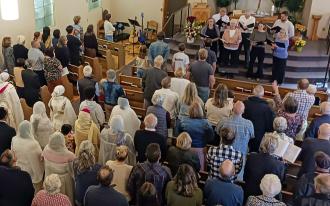
Congregations that share the First CRC building worship together Oct. 18, 2026, as the church celebrated its centenary.
A congregational banquet, community dinner, and a choir night were all part of the week’s festivities.
Over the past months the church drew attention to their defining moments by decade.
In 1944, Dutch Princess Juliana, later queen of the Netherlands, who was offered safety in Ottawa, attended a communion service, an event a few older church members remember fondly.
In 1949, church members founded Calvin Christian School, now Vancouver Christian, with a diverse student body of 950. When a wave of post-WWII immigrants arrived, First CRC began daughtering congregations throughout the Lower Mainland.
In the late 1960s, First CRC initiated the Seafarer’s Ministry. In the 1970s, First CRC joined other congregations in welcoming Vietnamese refugees, sharing their space with a newly formed Vietnamese congregation. Later, hosting community dinners, offering English-language classes and creating a large community garden became part of the fabric of this congregation.
In 2016, the Immigration Services Society of B.C. opened its doors in a new building on land directly adjacent to and previously owned by First CRC. Responding to this new neighbor and an influx of refugees from Syria, B.C., churches, including First CRC, funded a chaplain and refugee support mobilizer position and hired First member Dena Nicolai.
First CRC played a role in the formation of women pastors in the denomination. In 1995, the same year synod said a classis “may authorize the churches under its jurisdiction to ordain and install women in the offices of elder, minister, and evangelist,” First CRC opened all offices to women. At the time of its 90th anniversary, 5% of the women ordained as pastors in the denomination had served as interns, pastors, or had their membership at First CRC.
While anticipating its centennial anniversary and desiring to engage the CRCNA’s discernment process regarding the 2021 human sexuality report, the council began hosting listening circles based on restorative practices that same year. Synod 2022 recommended the report to churches as “a useful summary of biblical teaching regarding human sexuality” and declared that the church’s teaching against “unchastity,” which it defined to include “homosexual sex,” was a confessional teaching—one that officebearers in the church must uphold.
Between 2021 and 2024, First CRC’s council, with support from the congregation, sent an overture on confessional status, another on gravamen (a tool within Church Order that officebearers use to express a difficulty with a church teaching, affirmed by synod in 2024 as “not meant to be, nor should be, used as an exception to the confessions”), and a protest communication lamenting concerns about syndodical decisions that would impact First CRC’s ability to function within its mission and vision.
Classis B.C. Northwest encouraged First CRC’s council to send this to synod, which subsequently determined that churches and officebearers in ecclesial protest should be disciplined for the purpose of “restoration and reconciliation.” Classis refrained from enacting discipline until they better understood First CRC's response to the implications of the human sexuality report. Subsequently, Synod 2024 and Synod 2025's decisions to define “without reservation” and to alter the gravamen process—clarifying it as “temporary” in Church Order and laying out a timeframe for resolution—became the crux of the issue for First CRC's potential officebearers.
Classical church visitors observed in a January 2026 report to classis that “there seems to be much love, encouragement, ministry, and engagement together. In many ways we see them (as) a ‘New Testament’ church—worship, prayer, lots of food together, teaching, various ministries, and a true love and affection for one another.” The visitors also noted that along with frustration, disappointment and a sense of powerlessness, there is grief over “not having the same life-giving connection with the denomination as First CRC has experienced in the past. As weighty and potentially polarizing as these issues can be, there is genuine care—not hostility—in the congregation.”
After all its rounds of listening and discerning, First CRC's council has recommended disaffiliation from the Christian Reformed Church. The congregation held its first vote on the matter Sept. 15. The vote result was a strong mandate to proceed (with two negative votes and two abstentions.) Several round-table opportunities were provided for congregants to understand clearly what is at stake for the church. The follow-up ballot, as required by Church Order, will take place Nov. 17.
Council chair Joel Pel, who was born into First CRC in the 1980s, acknowledges the mixed emotions of leading this congregation through this time of celebration and discernment over what’s next. “There is deep gratitude for the rich history of this church and other CRC institutions like Christian schools that have shaped our theology and practices so richly. Simultaneously, it feels like some of the things we thought to be true of the CRC may no longer be.”