
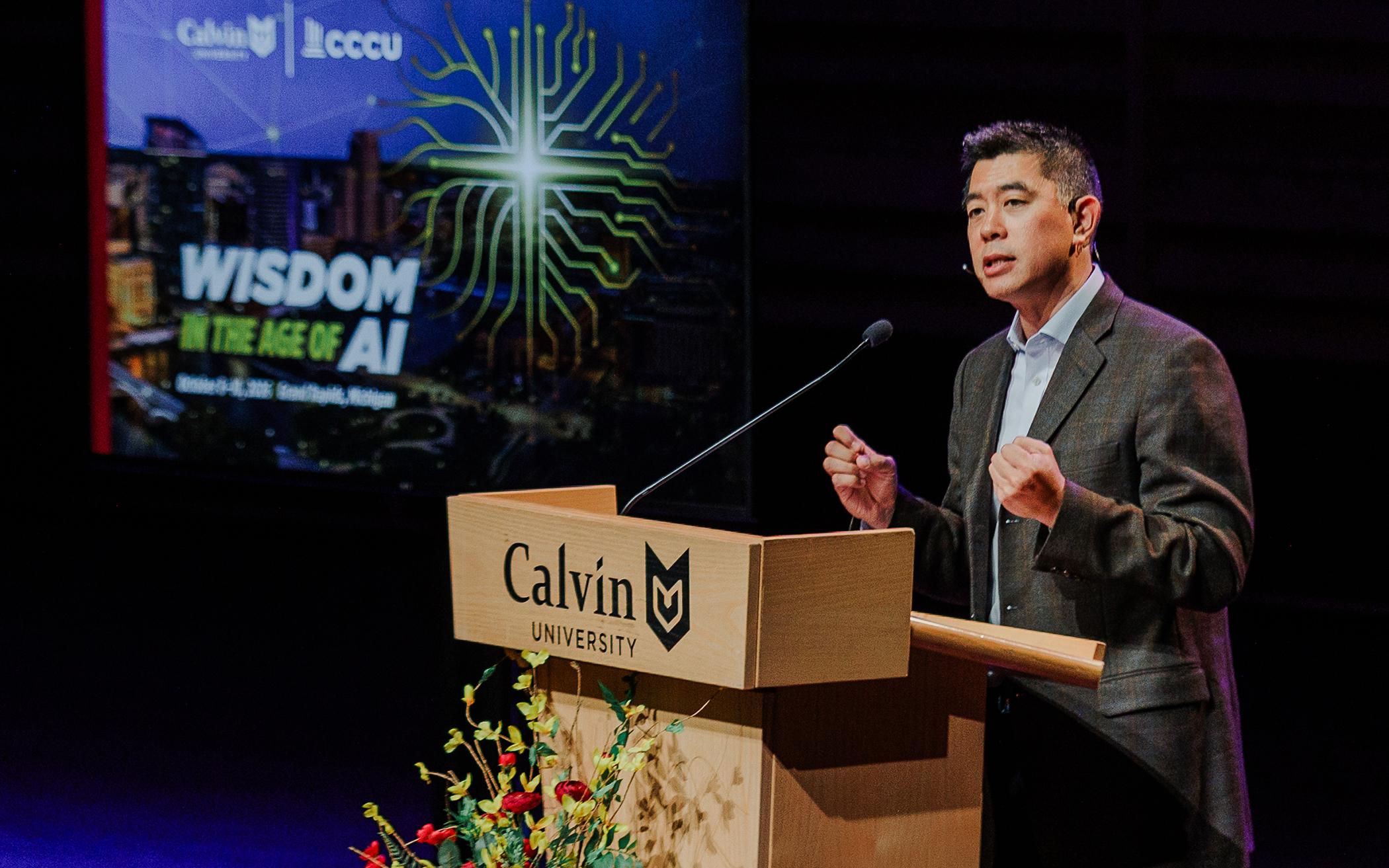
With more than double the initially expected registrants, and presenters and attendees from around the globe, Calvin University’s Wisdom in the Age of AI conference Oct. 8-10 facilitated the discerning of faithful and responsible use of AI in education, church, business, healthcare, STEM (science, technology, engineering, and mathematics), and the arts. The conference was also the venue for announcing Calvin’s newly formed Center for Faith and Technology.
Calvin’s Derek Schuurman, professor and chair of computer science and director of the AI conference, was named director for the Center for Faith and Technology by Calvin University president Greg Elzinga at the opening event. The new center will fall within the School of Engineering and Computer Science, launched earlier this year. Initial funding was provided by a legacy grant from the Calvin Center for Christian Scholarship.
“We want to be a wise, winsome Christian voice in how to responsibly employ this technology,” said Schuurman. “The 2,000 years of Christian thinking has something to say about what it means to be human, about what is the structure of created reality. We want to join the conversation.”
Schuurman said planners had hoped for 250-300 attendees, but numbers kept growing, with 658 full-conference registrants in the end. “There is a profound hunger for convening with other Christians to engage this topic through a Christian lens,” he said.
Attendees and presenters came from as far away as the Netherlands, Lithuania, Indonesia, and across the United States and Canada. Abraham Kunz and Willemieke Neijnount, both instructors at Driestar Christian University for Teacher Education in South Holland, Netherlands, were eager to bridge AI and education.
“It’s not about simple answers, but thinking more profoundly about the influence of technology and AI,” said Kunz. “And it’s not about building higher and higher walls regarding our calling.”
Presenters were chosen after a call for papers that were then evaluated by Calvin’s experts in the various tracks. Kelly Klerk, manager of strategic initiatives, research, and operations at Grand Valley State University, presented in the health track with two colleagues. The team developed an immersive operating room using virtual reality and augmented reality to add to nursing students’ clinical hours.
“We want to share what we’re doing and are working on creating other uses for this technology,” she said. “We need to teach our students how to use AI ethically and responsibly.”
Israel “Izzy” Soong, who works in tech at the CIA and is an adjunct professor at Johns Hopkins School of Advanced International Studies, opened the AI conference with his keynote titled “A Better Eschatology: Toward AI-Enabled Human Flourishing.” He spoke of two differing views of the future: a technology utopia, in which all of life is flourishing, and an AI apocalypse, in which the world is doomed.
“But Christianity has a better eschatology than either of those,” said Soong in his talk. “One that focuses on wisdom as we place our hope in God. Let us boldly claim the truths of our Christian faith. May everything we do in this age of AI be signposts to the more important heavenly age to come.”
Steven Schmidt, a retired physician from Neenah, Wisc., came to the conference in his role as an elder and senior high school teacher in his Orthodox Presbyterian church. He saw use of AI as a diagnostic tool in his medical practice, yet wants to help students navigate AI use well.
“I wanted to learn more about a Reformed theological way of thinking about this topic without falling into the trap of a dystopian or utopian future,” said Schmidt. “Since AI has become a factor and is having an impact on every walk of life, it’s important for the kids to approach it in a way consistent with Christian faith.”
Five keynotes anchored the event: Soong; Megan Sullivan, who spoke on “The Dignity of Learning in the Age of Power AI” in a prerecorded session; Andy Crouch, whose talk was titled “Waking From Our AI Dreams”; Rosalind Picard, who asked “Are We Merely Machines?”; and Ryan Struyk, whose talk was titled “The Future of AI and News.” Presenters included AI researchers, tech company founders, healthcare professionals, pastors, and educators.
Struyk, whose keynote talk ended the conference Saturday, is director of AI Innovation at CNN. He focuses on how CNN uses AI in the newsroom for news gathering and reporting, investigative journalism, editorial workflows, information gathering, and education and training for journalists.
“This conference is a fantastic opportunity to step back and think critically about how to integrate AI into our work in thoughtful ways,” said Struyk, who graduated from Calvin in 2014 with degrees in political science and math. He was also editor-in-chief of Calvin’s student newspaper The Chimes and a reporter for The Banner.
“Our faith doesn’t stop at the church or classroom door. As someone sent out by Calvin, I’m making hard and complicated decisions about AI every day. My faith animates the way I integrate AI in my work as a journalist. It’s important for people of faith to help find the best ways to integrate AI into our careers,” Struyk said.
“AI is going to dramatically change the way we consume information, and it’s a great privilege to be part of that conversation,” he added.
Schuurman said there are no concrete plans yet for a second Wisdom in the Age of AI conference, though a new book Schuurman edited, Christian Wisdom for the Age of AI: Insights for Education, Health Care, Vocation, Culture and the Church, will be released with IVP Academic in July 2027. There is also a curated hub of online resources on faith and technology—including books, podcasts, and video—in the works.
“Unlike other issues that divide people, the AI issue is rallying Christians from a wide variety of Protestant traditions. The issue is less polarizing, and we can work together more widely and contribute to the conversation,” said Schuurman. “The Christian faith has important resources to inform our cultural moment with AI.”
About the Author
Ann Byle is a freelance writer for a number of publications and author of Chicken Scratch: Lessons on Living Creatively from a Flock of Hens.