
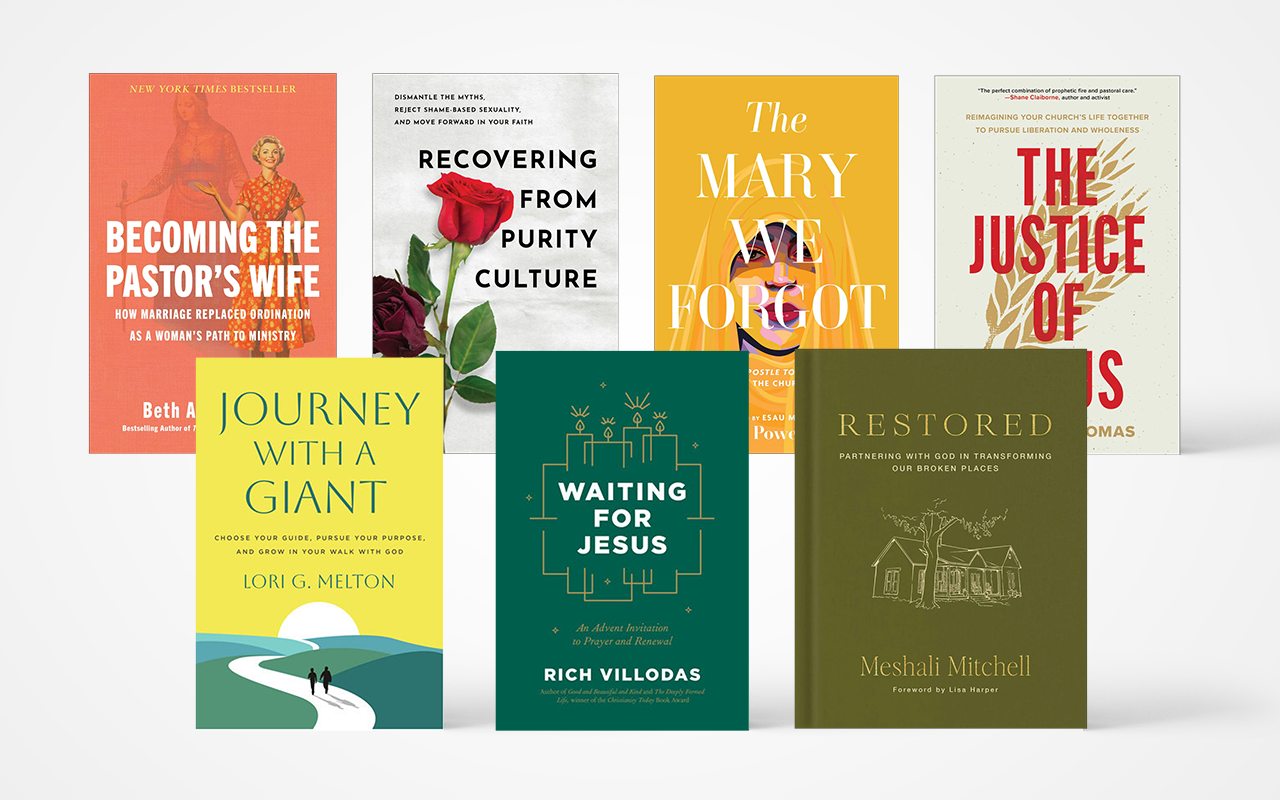
It’s a privilege to read a wide array of faith-based, nonfiction books for possible review in The Banner. I love sharing these books with readers! Here are a few of my favorites of 2025 that fit our Christian Reformed worldview.
Journey With a Giant
By Lori Melton
Few Christian living books have a premise as unique as Lori G. Melton’s Journey with a Giant. The Allegan, Mich.-based spiritual director shares her formative journey with Mister (Fred) Rogers as she guides readers in choosing their own “giant” of the faith.
Drawing from Hebrews 12 and the “cloud of witnesses” described there, Melton demonstrates how everyday Christians can be more deeply formed in Christlikeness as they are discipled and mentored by believers, both famous and obscure. It’s iron sharpening iron across time and space.
Melton chose Mister Rogers, whom she calls “Fred” throughout the book. Rogers was a devout believer, a Presbyterian minister who felt called to show compassion and kindness to children through his beloved TV program, Mister Rogers’ Neighborhood. Readers will be encouraged and moved by Rogers’ faith life, a life of acceptance and love fueled by a steady practice of spiritual silence.
Readers might consider going through the book twice: once to understand the concept of journeying with a giant and again to guide the journey.
“I had grown accustomed to sharing life with spiritual companions, taking them my questions and fears, and letting their lives speak into mine,” Melton writes. These companions don’t replace Christ, but rather instruct and encourage believers to discover new insights about him through their lives and writings. (Waterbrook)
Restored: Partnering With God in Transforming Our Broken Places
By Meshali Mitchell
For anyone who loves home restoration shows on HGTV and thumbing through glossy home magazines for inspiration, Restored takes the concept of a home makeover to the next level with the author’s deep soul restoration detailed alongside the renovations of her old Texas farmhouse.
Photographer and portrait artist Meshali Mitchell had no idea what she was in for as she began to restore her house, with its lovely old bones, cracks in the plaster, and shifting foundation. She was on her own journey of healing from wounds that had held her captive for far too long. In this book, replete with stunning photographs, Mitchell takes readers along as she heals and rebuilds along with her home.
I adored this book with the author’s sumptuous, profound writing and gauzy, dreamy photos. Mitchell is admirably vulnerable and makes the reader feel as if they are not so alone in their own journeys of restoration.
Richly wrought, wise, and healing, Restored brings the gift of Christ-centered self-care and soul care to readers and those they love. (Revell)
Recovering from Purity Culture: Dismantle the Myths, Reject Shame-Based Sexuality, and Move Forward in Your Faith
By Dr. Camden Morgante
Dr. Camden Morgante’s openhearted and empathetic book is a trove of insight into deconstructing the harmful messages of “purity culture” and replacing them with healthy, hopeful, and restorative precepts. Though purity culture dominated the Evangelical world in the 1990s and 2000s, with fervent “purity ring” ceremonies, “purity balls,” and “True Love Waits” rallies, it was already woven into the fabric of Evangelical culture for many years.
Both women and men were hyper-sexualized by these teachings, with women’s bodies being seen as dangerous and threatening and men being deemed unable to control themselves. This construct dehumanizes men and women and leaves little room for forgiveness and restoration.
Morgante proposes another way—the “shaping of a sexual ethic that aligns with our values and beliefs without the weight of shame and control hovering over us.”
There is “good fruit” to be born when believers embrace a robust, grace-filled, “values-congruent” sexual ethic that honors God-given sexuality. “No longer wounded by our past, we can choose to live integrated lives, with our body, heart, and soul in alignment with God’s will for us,” she writes.
Wise, profound, and hope-filled, Recovering From Purity Culture is a gift to anyone who wants to disentangle from the harmful messages of these teachings. There is a path forward, Morgante encourages her readers. And it is filled with so much goodness. (BakerBooks)
The Mary We Forgot: What the Apostle to the Apostles Teaches the Church Today
By Jennifer Powell McNutt
As I read this bountiful and emboldening book about Mary Magdalene, my admiration for the first witness to the resurrection grew. What a brave, generous, unwavering disciple she was, and how much I had missed or been confused about her through many years of studying Scripture and even four years of Bible college!
A theology and history professor at Wheaton, Jennifer Powell MacNutt has her work cut out for her to help us understand who Mary wasn’t before we understand who she was. She wasn’t a prostitute, for one, and the fact that she was thus sexualized and scandalized all these years hides who she was, to the detriment of every believer. Because when we pay close attention to this disciple of Jesus, we are drawn closer to the one who loved, healed, called, and sent her.
I relish that Mary Magdalene, after Jesus ascended to heaven, is said by church tradition to have traveled to Europe on a “rudderless boat” in the dark of night with Martha and Lazarus to share the gospel. She is known as the “Apostle to France.” And I savor the fact that, now that I know who she was, I have a new role model to inspire and teach me.
“Are we ready to receive the one who was sent by Christ?” concludes MacNutt at the end of this book. “Are we ready to run with her?” (Brazos Press)
Becoming the Pastor’s Wife: How Marriage Replaced Ordination as a Woman’s Path to Ministry
By Beth Allison Barr
You will find new heroines to admire in the pages of Becoming the Pastor’s Wife. by Beth Allison Barr, author of The Making of Biblical Womanhood.
She highlights ancient women such as the biblical Junia and Priscilla, who were lauded by Paul in Scripture for their church leadership.
Barr introduces us to the fifth-century iconography of two women, Cerula and Bitalia, wearing liturgical garb, as well as other iconographic and archeological evidence that women led church communities. There was Queen Bertha of Kent, a French princess of faith who was hugely influential in introducing Christianity to England. Abbess Milburga, one of my favorites in the book, was born in the mid-seventh century and became a “powerful bishop in the church, providing oversight and pastoral care to laity and clergy.”
But along the path of time, something changed. Barr makes a strong case that women were ordained for the first 1,200 years of Christianity, until they weren’t. The reasons are complex and varied. Historical forces began to bend and shape cultural mores until it became the norm for women to handle domestic duties and men to handle leadership roles. But in Barr’s opinion, this reshaping of women’s roles can be traced from history, not the Bible. (Brazos Press)
The Justice of Jesus: Reimagining Your Church’s Life Together to Pursue Liberation and Wholeness
By Joash P. Thomas
Joash Thomas has many compelling, visionary stories in his book, The Justice of Jesus, but one that caught my attention is about the Church of England and the transatlantic slave trade of almost 200 years ago. In 2023, the church learned that its past leaders had invested almost $1 billion in today’s currency into the slave trade. The modern church announced that they would create a fund of 100 million pounds for community projects “addressing the aftermath of slavery.” It’s just one real-life success story (though not without pushback and complications) Thomas describes in his practical and inspiring book.
He even mentions a Christian Reformed church—Talbot Street CRC in London, Ont.—and how they raised almost $100,000 to fund rescue operations for children being sexually exploited in the Philippines.
The justice of Jesus, says Thomas, is not political. It’s a matter that goes to the heart of the gospel described in Luke 4:18: good news for the poor, recovery of sight for the blind “to set free those who are oppressed.” This kind of justice is more than just a “hyper spiritual, soul salvation, punch your ticket to heaven good news that ignores people crying out for physical liberation,” he writes.
This kind of justice should inform and shape our whole lives, from our personal and church budgets to our prayer lives and our willingness to advocate for those who are oppressed by unjust systems.
To engage might mean rolling up our sleeves and getting dirty in the process. Thomas tells of Dutch theologian Rozemarijn van’t Einde, who advocates for climate justice with other Dutch church leaders and rejects the idea that people have to be nice and accommodating all the time. Jesus, after all, got angry at the money changers and the Pharisees. “We are called to be salt of the earth,” she told Thomas. “Not sugar of the earth.”
As someone who is from India and has lived in the U.S. and now in Canada, Thomas is uniquely qualified to speak into the ramifications of a “Western gospel” whose adherents sometimes think they offer the only path to a proper relationship with God. Thomas’s own Southern Indian family traces its faith back to the Apostle Thomas, who is believed to have brought the gospel to his ancestors in AD 52. “Some of our ancestors were worshipping Jesus in the same era when many white Europeans were still worshipping pagan gods like Thor,” he said. I had never heard of “Mar Thoma” Christians and loved learning about them. It broadened my view of a global church that can teach me and other Christians from a Western worldview so much about what it means to live out faith in Christ.
While diagnosing the issues facing the North American church, Thomas also fulfills his promise to “lean toward a hopeful prognosis.” I closed the book brimming with ideas and mindset shifts on how I can prioritize and promote justice. (Brazos Press)
Waiting for Jesus: An Advent Invitation to Prayer and Renewal
By Rich Villodas
Once again a Christmas book will make my Best of Books list at the 11th hour. Last year it was A.J. Sherrill’s Rediscovering Christmas, and this year it is Waiting for Jesus, by Rich Villodas, the author of Good and Beautiful and Kind, another book that made my list when it came out.
Villodas has a winsome way of blending theology with our practical, everyday lives, and this posture is especially evident in this advent book. In a season of scurrying around, doing laundry for coming guests, wrapping presents (where oh where is the tape?), endless grocery shopping and cooking and baking, Villodas invites us to pause, rest, and listen for the voice of Emmanuel.
Slow down, he says. Let the main thing—Christ—be the main thing. Let his peace permeate all the chores and rushing and tape-finding that still exist in the world in which we live.
“In Advent, we are invited to wrestle with our longings, desires and hopes for a world marked by grace, goodness and peace,” Villodas writes. “It is a time to recall the biblical truth that the renewal of our lives and our world is found in God’s coming among us in Jesus Christ.”
The 25 devotions are broken into four parts, beginning with waiting. God works in the dark, and in the waiting, Advent breaks through with light.
Every devotional features a reading, Scripture, reflections, and an invitation to pause for two minutes to be with and listen to God’s voice, and for the “kind of counsel only God can give us.”
Part two is Peacemaking, a gift and an endeavor that is more challenging than ever in a world where “the spirit of Herod” pervades our society. This spirit is antithetical to the spirit of the Christ child. “In coming as an infant, unarmed and vulnerable, he established the way of his kingdom from the onset. The kingdom is not characterized by fear, self-interest or violence. It's defined by vulnerable trust and supernatural love.”
Rejoicing is the third section, and it helps the reader understand that joy is not something to be forced but to cultivate with God’s help. Villodas also reminds readers that while we hold joy in one hand, we can also hold sorrow in the other. “This advent season, remember that the same Bible that says rejoice always (Phil. 4:4) has a book called Lamentations.” The “most wonderful season of all” can also be very painful.
Finally, Part 4 is Beholding. “Behold,” says one theologian quoted by Villodas, might be the most important word in the Bible.
“With Christianity, it’s easy to focus on believing and behaving, but what often goes overlooked is the spiritual habit of beholding,” he writes.
In advent, we wait and ponder, seek the peace of our hearts, our neighborhoods, and our world. We draw near to God, the only source of true rejoicing, and behold his presence with us and for us, at Christmastime and 365 days of the year.
“While none of us will receive Mary’s call to give birth to Jesus, we all have an invitation from God to help renew the world,” Villodas writes. “In big and small ways we can partner with him to bring light into it.” (Waterbrook Press)
About the Author
Lorilee Craker, a native of Winnipeg, Man., lives in Grand Rapids, Mich. The author of 16 books, she is the Mixed Media editor of The Banner. Her latest book is called Eat Like a Heroine: Nourish and Flourish With Bookish Stars From Anne of Green Gables to Zora Neale Hurston.