
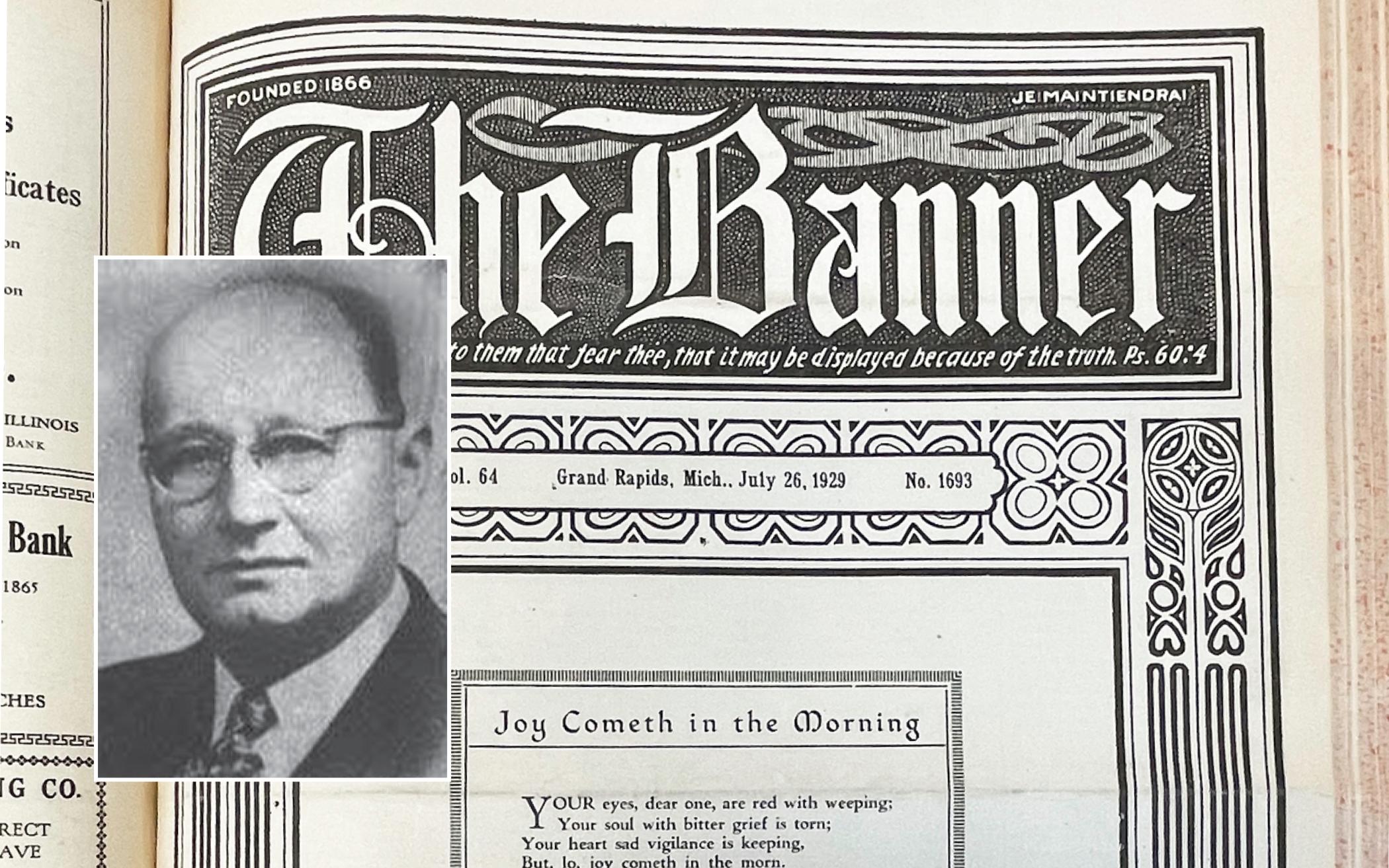
Note: This online-only article is part of a series showcasing past Banner editors. You can read all the content celebrating The Banner’s 160th anniversary here.
One hardly knows where to start in writing about Rev. Henry J. Kuiper. He was the longest-serving editor of The Banner, leading in that role for 28 years after his appointment in 1928. If his predecessor Rev. Henry Beets was known as the man for all seasons in the Christian Reformed Church, Kuiper was “Mr. CRC.”
Kuiper served as editor for 15 years part-time while also serving as full-time pastor of the Neland Avenue CRC in Grand Rapids, Mich. In 1944, a report to synod noted that subscriptions had risen from 11,000 to 31,000 during his tenure. “The load was crushing. He was crumpling,” the report read. Indeed, he ended up hospitalized. That year, the position was made full-time, and Kuiper remained editor until his retirement in 1956
H.J. Brinks, in “Burning Shoes and Banana Peels: 125 Years of The Banner,” wrote that unlike his predecessor Beets, Kuiper was not an immigrant. “He wrote as a more confident cultural insider, steering a course between fundamentalists and modernists. … He knew the Christian Reformed Church most intimately. All of this first-hand experience in the life of the church contributed much to his becoming known as the “voice” of the Christian Reformed Church through his long tenure as editor of The Banner.”
Not all readers of the paper appreciated that “voice,” wrote Edward Heerema for the Reformed Fellowship. “He made enemies in his fearless devotion to the cause of the Christian Reformed Church as he saw that cause. He was never afraid to show his mind on an issue, and his position was always unmistakably clear. His writing was never fuzzy or marked by that delightful vagueness that lets everybody think that the editor is on his side.”
Kuiper could be fierce in his criticism of those whose views he opposed, and he was not above using his influence as editor to his own advantage, wrote Cornelis Venema in a book review in Outlook.
In writing about Banner editors she had known, Gertrude Haan wrote that he was a remarkable man, with an exceptionally strong personality: gracious and urbane in public, but caustic when he encountered what he deemed to be heresy or false doctrine.
Exhausting Controversies
In Origins, H.J. Brinks wrote in “The CRC in the 1920s, The Era of Henry J. Kuiper” that it grieved (Kuiper) that he was forced to expend his initial years as Banner editor either in controversy or in shoring up the achievements of an earlier, more creative Dutch-American Calvinism. Kuiper noted that the denomination had been forced to exhaust its energies first in battles with divisive debates about common grace and the assaults of materialism and worldly mindedness. “During the prosperous twenties, when the CRC should have been strengthening and expanding a distinctively reformed witness, the denomination gained little or nothing,” he wrote.
Further on, Brinks writes that Kuiper argued that the buoyant revival of Calvinism, which had inspired the Christian Reformed Church before World War I, had become seriously diminished. “Unless we retrace our steps and dedicate ourselves anew... to the development of everything in our Calvinistic heritage,” (Kuiper) declared, “we shall gradually become a conglomerate of religious groups ... and inevitably we will break up into the least three elements—the one clinging to historical Calvinism, the other espousing to sort of fundamentalist evangelicalism, and another inclined to follow in the wake of liberal socializing modernistic churches of our land.” He believed that many Christian Reformed congregations adopted English prematurely and with the accelerated loss of Dutch, the rising generation could no longer “read the precious theological works of our reformed theologians in the Netherlands.”
Piety and Purity
In his review of James A. De Jong’s biography Henry J. Kuiper: Shaping the Christian Reformed Church, 1907-1962 Venema wrote that Kuiper stressed catechism, discipline in families, doctrinal preaching, and warnings against worldliness. Indeed, Kuiper wrote dedicated lengthy editorials on the evils of worldly amusements, including no less than four multi-page editorials on movies.
Venema continued, “Prominent themes in Kuiper's view of the Christian life were: the cultivation of personal piety and devotion, the development of a healthy covenant home environment with meaningful family devotions, a Reformed world view that embraces all of life, a rigorous but joyful use of the Sabbath for Christian worship and service, a diaconal interest in the needs of recent Canadian immigrants, the cultivation of a healthy and vigorous church life and ministry, and the promotion of a proper kind of denominational loyalty and self-awareness.
“Kuiper opposed inappropriate alliances with liberal churches and cautioned against ecumenical contacts that would compromise the confessional character of the CRC. Kuiper was an advocate, however, of membership in the National Association of Evangelicals and welcomed enthusiastically the formation of the Reformed Ecumenical Synod (now Council).”
That organization merged into the World Communion of Reformed Churches in 2010. The CRC’s 2026 decision to withdraw from that body gave a more recent context for Kuiper’s concern about ecumenicity and confessionality.
Brinks, in Origins, wrote that Kuiper saw the Christian school movement as the best opportunity to advance Reformed principles and institutions. At all levels—primary, secondary, and college—The Banner encouraged the expansion of Christian schools. Wrote Kuiper, “If they fail, we fail.”
In 1927 several CRC congregations had also begun to broadcast worship services for shut-ins. Synod 1930 rejected a proposal that the denomination appoint a radio minister. Kuiper was incensed, wrote Brinks. “Let us make use of the radio to propagate the true Gospel of Jesus Christ,” Kuiper urged, “for we believe that our reformed Doctrine is the purest interpretation of the gospel, we believe that our calvinist world and life view is the only hope for the modern world in its intellectual bewilderment and moral confusion. Bewilderment, particularly in religious broadcasting, required a reformed alternative.” In 1939 the proposal finally succeeded. The Back to God Hour (now ReFrame Ministries) reached its first audience from station WJJD in Chicago.
Worship and Liturgy
More than anything else, Kuiper was passionate about worship and liturgy, writing 106 editorials on those topics. He also promoted family worship times, which he called the “family altar.” James A. De Jong wrote in Origins that Kuiper only wrote eight on preaching because preaching was not in dispute, while worship and liturgy were hot topics. In fact, before becoming Banner editor, his involvement at the synodical level was shaped by his considerable liturgical interest and experiences.
According to De Jong, Kuiper became increasingly anxious that CRC people were making indiscriminate use of readily available English-language hymns. Many of these were questionable or mistaken in theological quality. William Eerdmans, founder of the Eerdmans Publishing Company, invited him and several others to compile a hymnal for those who love the Evangelical faith. That work mainly fell on Kuiper, and The New Christian Hymnal was published in 1929.
Kuiper outlined in his preface the criteria for the 451 hymns selected for inclusion: theological soundness; suitability for general use; and singability. A collection of hymns for children and a selection of chorales were also included.
The hymnal was perhaps the greatest achievement of Kuiper's life, De Jong wrote. However, the same synod that appointed Kuiper to The Banner declined to appoint a committee to study the new hymnal despite protestations that many hymnals currently used were “doctrinally unsound and a menace to the purity of our churches.”
During the 1930s he kept the church informed on progress being made and selecting suitable hymns, and he served on the committee that produced the first Psalter Hymnal in 1934.
In 1948, Kuiper wrote a whole series on congregational singing and its legitimate use. He was a friend and encourager of church organists. “Contrary to those who think that the 1920s through the 1940s were years when Christian Reformed people were uninformed and indifferent concerning the subject (of worship), the church got full and regular instruction on worship and liturgy. … It is doubtful that anyone before or since has had as great an impact on Christian Reformed worship,” De Jong wrote.
During and After The Banner
Kuiper was the first president of the Chicago Helping Hand Mission Board, chairman of the Grand Rapids City Mission Board for 15 years, first president of the Grand Rapids Christian High School Board, second president of the Young Calvinist League (then known as the A.F.R.Y.M.S.), and president of the Board of the Reformed Bible Institute from its inception in 1939 to his death. He was delegate nine times to the synod of the CRC, twice chosen as vice-president and elected president twice.
He was one of the founders of the Evangelical Press Association and its second president. The Banner remains a member of that association to this day.
Following Kuiper’s retirement from The Banner, he accepted the invitation of the Reformed Fellowship to become managing editor of Torch and Trumpet (now Outlook).
Mr. CRC
In his review in Outlook, Venema said that as editor of The Banner “Kuiper deserves to be described as ‘Mr. CRC.’ The character of the CRC, the challenges confronting a confessionally Reformed and immigrant church in North America, the great theological debates that preoccupied the early decades of the 20th century, the extraordinary institutional development of the CRC, the common convictions of denominational members during this period—all of these and more are embodied in the person of Kuiper.”
James Bratt, the author of Dutch Calvinism in Modern America, wrote, “Indeed, as his tenure lengthened it became increasingly difficult to distinguish between the man, the periodical, and the group they served.” He wrote that Kuiper was “the authority on all matters of truth and morals, a voice whose every word was to be eagerly awaited, treasured, and—most of
About the Author
Gayla Postma retired as news editor for The Banner in 2020.