
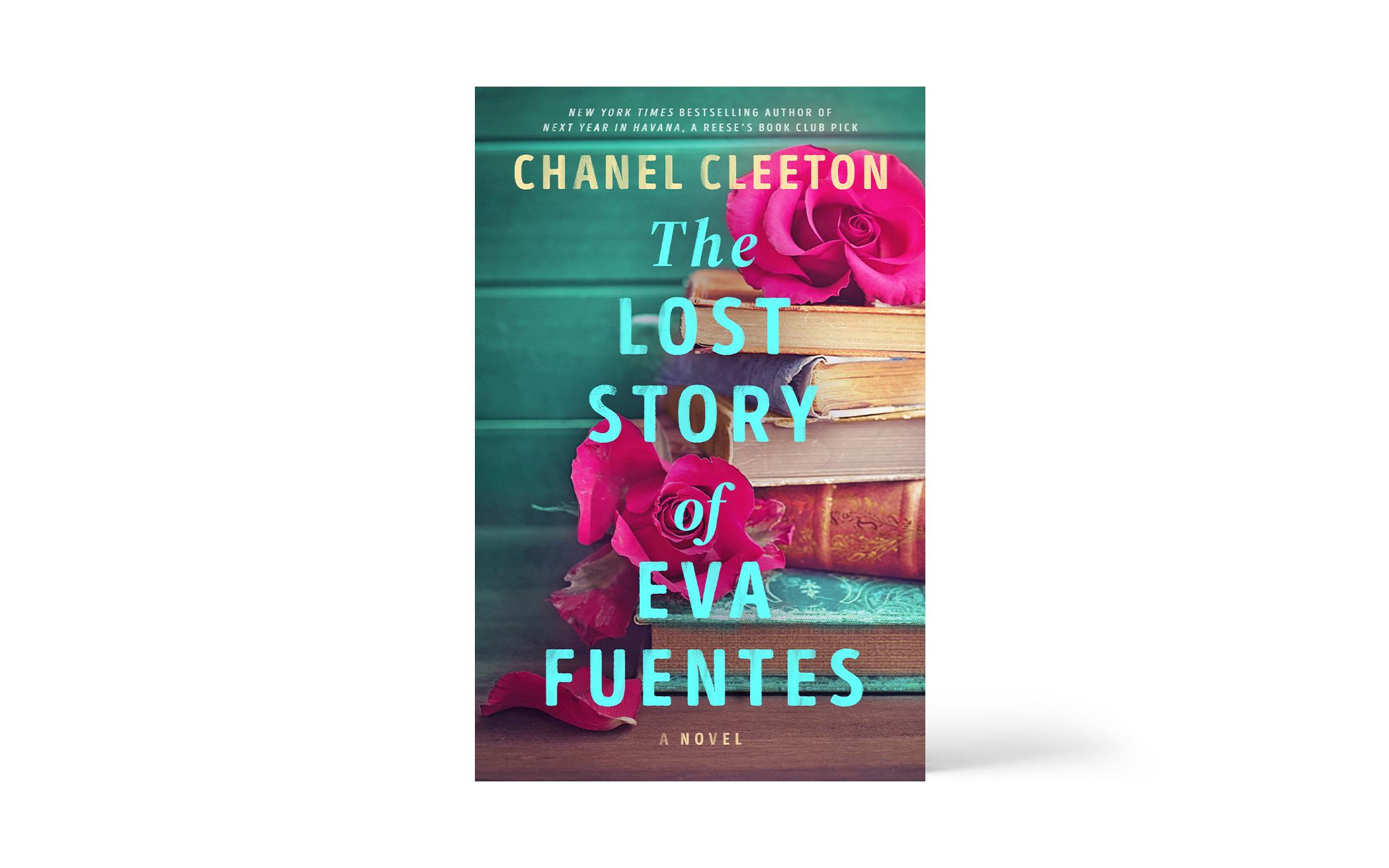
The Lost Story of Eva Fuentes
By Chanel Cleeton
Reviewed by Lorilee Craker
I love a book that connects the past with the present, and when that book teaches me about a little-known piece of history and another country and culture? Even better.
The Lost Story of Eva Fuentes weaves the stories of three women who all have a connection to an obscure book whose secrets propel the action from the first page to the last.
London, 2024: Spanning almost a century, this historical novel begins in present day, when American Margo Reynolds is hired to find a mysterious book published almost 100 years ago. With her sterling reputation as a finder of lost antiques, Margo is sure she can locate the book, but all her usual methods—including working with an old bookseller—come up short. Worse, it soon becomes obvious that others are seeking the same book, and they will use violence to obtain it.
Havana, 1966: Librarian Pilar Castillo lends and shelves books by day and fights Fidel Castro’s regime by night, hiding valuable books entrusted to her by dissidents departing Cuba. While grieving the unjust imprisonment of her husband, helping her neighbors and reading books is her only comfort. When a neighbor fleeing Cuba asks her to return a rare book to its author, Pilar’s life is more in danger than ever.
Boston, 1900: Eva Fuentes travels from Cuba to Harvard as part of a historic cultural exchange for Cuban teachers. An unexpected romance and a fateful summer lead her to write a story filled with secrets and love, never knowing how this book will touch the lives of those who encounter it.
In Pilar’s era, readers will learn about Cuban history, as Cleeton reveals the harsh realities, fear, and oppression under Fidel Castro’s regime, featuring the mass imprisonment of citizens and the tyranny of censorship. In Eva’s era, they will learn about the aftermath of Spain’s colonial rule and America’s military occupation as Cuba tries to stand on its own.
Having read and relished Chanel Cleeton’s books before, I knew that she could be trusted to weave in and out of the 10 decades depicted and the lives of these three characters. Finding the answer to how their stories tie together makes for a satisfying, thought-provoking ending. Christians who read the book will be reminded of how many people around the world live in dictatorships, and how truth and goodness can be suppressed by evil. They might be inspired to seek justice for image bearers whose freedoms are oppressed—in modern day Cuba and other places around the world.
(Penguin Random House)
My Name Is Emilia del Valle
By Isabel Allende
Reviewed by Sonya VanderVeen Feddema
In 1866, San Francisco, Calif., Emilia del Valle was born to Molly Walsh, a young Irish nun, who was abandoned by the aristocratic Chilean man who had on one occasion taken advantage of her naivete. For years, Molly’s rage against the absconder shaped Emilia’s life; Molly often told her daughter about a Chilean inheritance she was surely missing out on.
As a child, Emilia could not understand her mother’s rancor and the force with which it propelled her to keep Emilia cocooned and safe from life’s tragedies. When Molly married a man 20 years her senior, Emilia experienced for the first time what a loving, faithful father was like as he encouraged in her “insatiable curiosity,” a quality that became a driving force in her life. Emilia’s mother held a contrary view, that “curiosity is a liability in a woman. It leads to misfortune.” But Emilia cherished this trait: “This characteristic of mine has taken many forms over the years, but in essence it has kept me always looking around the next corner or over the horizon.”
Filled with a passion to write and the dream of becoming a novelist, Emilia begins writing pulp fiction in a dime novel format under a male pseudonym, since she knows she won’t be recognized as a female writer. When she applies for a job at the Daily Examiner, she secures a position as a columnist, again writing under a pseudonym, focusing on personal interest narratives since no woman is allowed to write news stories. That day, she meets news reporter Eric Whelan, and they become friends.
In 1891, Emilia is given an opportunity she could never have dreamed of. Civil war is brewing in Chile between government forces and the rebels. Emilia and Eric are assigned to cover the conflict, she as a columnist and he as a news reporter. Immediately, Emilia sees the opportunity to search for her father. When Molly hears of Emilia’s plans, she tries (and fails) to stop her.
In what becomes Emilia’s “Chilean odyssey,” she is caught up in the carnage of war, where brother turns on brother and atrocities impossible to adequately describe torment her body and mind. As she and Eric face similar traumas, their friendship deepens and they discover love. Still, nothing goes as planned, and when Emilia embarks on a dangerous journey to discover her roots, their relationship is tested to the breaking point.
Renowned Chilean American author Isabel Allende captures in Emilia’s character the extent to which a young woman living at the end of the 19th century would go to pursue her passion to become a novelist. Allende’s narrative, which includes some sexually explicit material and a range of religious beliefs, vividly portrays the insanity and absolute waste of human life in times of civil war, and the terrible burden and shame that linger years later in a society trying to return to normalcy. Allende also subtly critiques the abuse of indigenous people throughout Chilean history and reveals how the poor are the ultimate losers in any conflict.
(Ballantine Books)
Where Wilted Flowers Bloom
By Johanna Rojas Vann
Reviewed by Sonya VanderVeen Feddema
Sandra Brown has always felt secure in her marriage to her husband Aaron, in her role as a parent of two children, and in her prestigious career, which regularly boosts her self-esteem and affirms her gifts. And she loves living in New York City with her extended Colombian American family nearby, especially feeling close to her wise and pious mother and her loving sister, who, finally, after years of infertility, will be giving birth to a baby soon.
But when tragedy strikes and Sandra and Aaron’s third child dies, Sandra feels compelled to get away from the places that remind her of baby Rose. A job transfer from New York City to East Nashville, Tenn., offered to Aaron seems to Sandra like an opportune way to avoid her grief, though she’s not aware of how deeply entrenched is her desire to escape.
Against her family’s and Aaron’s better judgment, Sandra insists that they move, thereby beginning a lonely pattern of evasion of grief, one that is already negatively affecting her marriage and children.
In her large, newly constructed East Nashville home, Sandra notices an elderly man in the modest home next door sitting on his porch. Feeling unmoored in her new community and in her nascent role as a stay-at-home mom, Sandra is drawn into an unconventional friendship with Mark, the widowed, retired pastor of First Baptist Church, the congregation he had served for 30 years.
Sandra and her children visit Mark regularly in his lovely backyard garden, one that was established by his deceased wife, Thelma, and which he now meticulously maintains in her memory. Because Sandra always loved nurturing houseplants—there wasn’t the possibility of a large garden in the city—she finds in Mark’s garden a refuge from her grief.
As the two begin to share their stories—different kinds of losses, yet each acutely felt—Mark perceives the pressure that Rose’s death is having on Sandra and Aaron’s marriage. With wisdom gained from years of counseling people as a pastor, Mark helps Sandra to begin to understand how grief can change relationships forever, but how, even then, God is present in his goodness.
Now that Sandra has such a good friend in Mark, she’s sure she can continue to cope with her sorrow and to find her way in her new locale. But when she begins to notice that Mark is becoming forgetful, she’s drawn into a crisis that becomes a test of their relationship. Now she wonders if she can survive another loss.
Author Rojas Vann’s novel reveals her extraordinary and realistic understanding of the manifestations of grief—sorrow, depression, rage, destructive behavior, and more—and depicts her grasp of the truth that God’s unconditional love and power are sufficient for every circumstance. Rojas Vann’s portrayals of childbirth, the death of a child, the struggles faced by stay-at-home moms, the challenges of raising children, marriages under stress, and growing old rings authentically true.
In Where Wilted Flowers Bloom, readers will encounter a poignant story replete with authentic characters and much biblical wisdom to ponder.
(WaterBrook)
About the Authors
Lorilee Craker, a native of Winnipeg, Man., lives in Grand Rapids, Mich. The author of 16 books, she is the Mixed Media editor of The Banner. Her latest book is called Eat Like a Heroine: Nourish and Flourish With Bookish Stars From Anne of Green Gables to Zora Neale Hurston.
Sonya VanderVeen Feddema is a freelance writer and a member of Covenant CRC in St. Catharines, Ontario.